Join us
شارك معنا
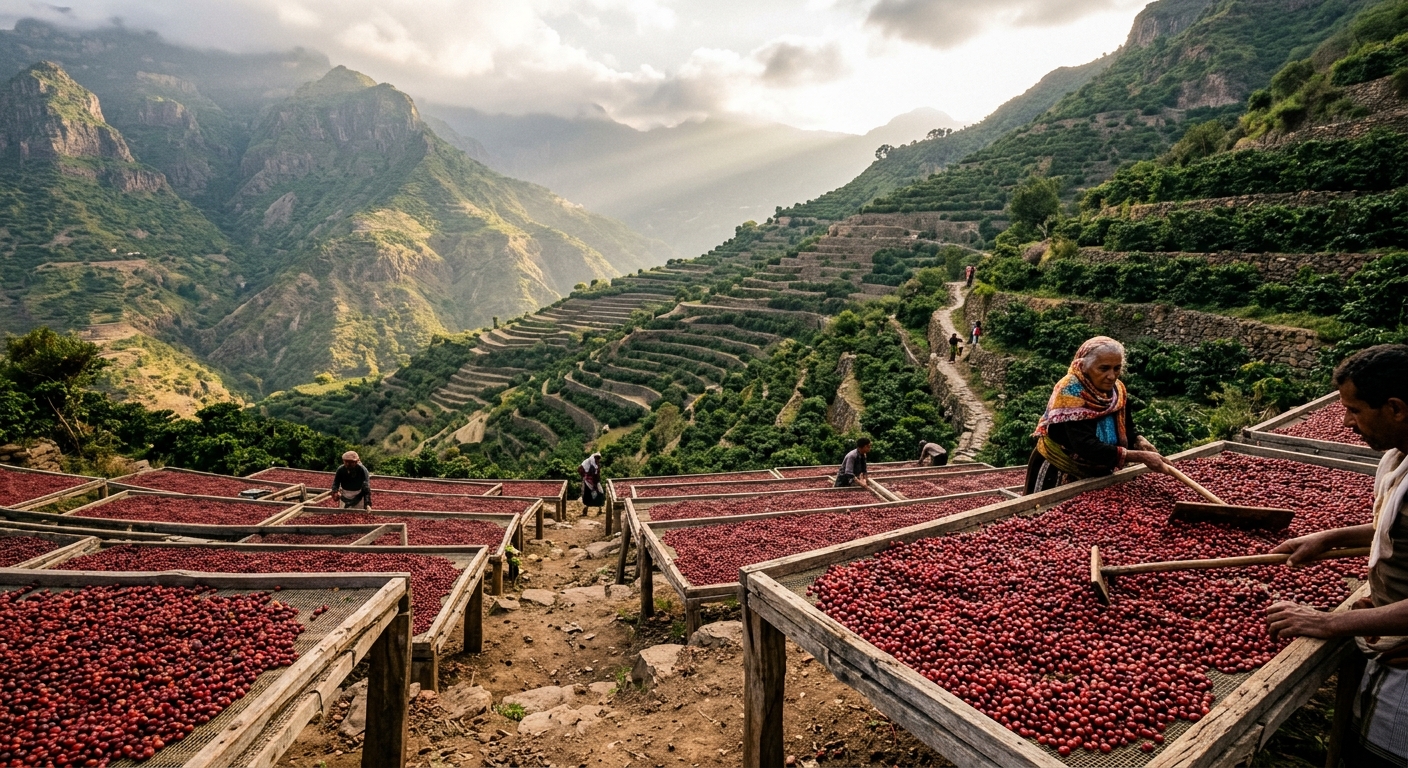
This study presents a comprehensive and structural analysis of the Yemeni coffee value chain for the year 2026, aiming to develop a practical roadmap to maximize the historical and economic value added to the crop. Although Yemeni coffee is distinguished globally by its exclusive, independent genetic lineage known as “Yemenia,” the value chain faces severe structural challenges that constrain its production and export capacities.
Official statistical data for the period (2017–2020) indicates stability in annual production, averaging approximately 20,000 tons over an estimated area of 34,000 hectares, with an average yield approaching 0.58 tons/hectare. Although statistics recorded an exceptional numerical leap in 2021, reaching 41,933 tons, methodical analysis suggests this surge is likely the result of improved data collection mechanisms, desk-based statistical documentation, and expanded geographical coverage, rather than a purely biological field boom. Consequently, it must be treated as a statistical outlier, and a more conservative production baseline should be adopted. Despite this, only 3,500 to 5,000 tons are officially exported annually. Meanwhile, local consumption and informal channels absorb between 75% and 90% of production (depending on the adopted baseline), representing a significant loss of strategic export value.
An analysis of the value chain stages reveals critical technical gaps. These begin in the input stage with poor seedling quality and the use of unfermented manure; progress through the production stage with the prevalence of the stem borer pest and the degradation of agricultural terraces; and culminate in the post-harvest stage with indiscriminate harvesting, primitive drying, and the flaws of traditional hulling. This post-harvest phase acts as a critical technical bottleneck, causing the loss of 40% to 60% of the crop’s value. Economically, farmers are trapped by the monopoly of “brokers,” lengthy supply chains, and the burden of “advance debt” (crop pledging), which drastically reduces their actual share of the final price. Accordingly, the study proposes a package of immediately fundable strategic interventions, such as constructing shared rural processing stations, training licensed Q-Graders, implementing Blockchain traceability technologies, and expanding direct digital auctions to break monopolies and channel returns directly to farmers.
Financially, the study demonstrates the exceptional feasibility of local import substitution. Yemen imports commercial coffee products and ready-made blends valued at approximately $56.25 million annually (estimates derived from customs data). By establishing local processing plants that utilize “export-rejected beans” as raw material, foreign currency can be preserved, yielding a direct financial surplus for investors ranging from the breakeven point up to 40% (depending on the production line and extraction efficiency). Furthermore, this would absorb the agricultural surplus and redirect financial returns to farmers—amounting to approximately $18 million annually (after correcting the conversion factor)—for products previously considered waste. If these technical practices, modern irrigation, and post-harvest reforms are implemented, current national exports are projected to gradually double or triple (reaching 10,000–15,000 tons in the medium term), injecting $250–$350 million annually into the balance of payments and cash reserves, moving beyond inflated, immediately unrealizable estimates.
The roots of the coffee tree run deep in human history. The towering mountains and unique agricultural terraces of Yemen represent the true cradle that witnessed the birth of coffee cultivation and the emergence of coffee culture as a global socio-economic beverage. Even the scientific nomenclature of the primary coffee species, Arabica, coined by Linnaeus in 1753, carries this heritage, derived from Yemen’s ancient name, “Arabia Felix” (Happy Arabia), which served as coffee’s gateway to the world.
In the 15th century CE, Sufis in Yemen developed methods for roasting coffee beans and brewing the boiled beverage to aid in night vigils and worship. This represents purely Yemeni intellectual property, as the coffee bean was transformed into a brewed beverage for the first time in history. From the famous Yemeni port of Mocha, ships set sail laden with “brown gold” to the rest of the world, historically associating the port’s name with the finest coffees globally (Mocha coffee).
In addition to these historical roots, Yemen possesses archaeological inscriptions and stone symbols confirming the antiquity of this legacy (though specialized archaeological documentation is required for further substantiation). Modern genetic studies also confirm the existence of coffee genotypes of purely Yemeni origin (the “Yemenia” family). The global spread of coffee cultivation is attributed to a series of colonial and scientific expeditions that transported coffee seedlings and beans from Yemen to Portuguese, Dutch, French, British, and Italian colonies beginning in the 17th century (when the Dutch transferred Mocha seedlings to Europe and then Java, followed by the French and British). This culminated in the Royal Danish Scientific Expedition to Arabia (1761–1767), led by Carsten Niebuhr and his student Peter Forsskål, which extracted the first documented scientific coffee sample from Yemen to Europe.
Today, coffee is one of the most widely traded tropical agricultural commodities internationally, with global coffee exports valued at approximately $20 to $30 billion annually, alongside the rapid growth of the “Specialty Coffee” sector, which seeks rare and unique sensory profiles. In this massive market, Yemeni coffee holds an exceptional, almost mythical status. It is not treated as a standard commercial commodity but as a luxury, ultra-specialty product (Gourmet/Ultra-Specialty) owing to the high altitudes where it is grown (1,000–2,500 meters above sea level), unique climatic conditions involving adaptation to partial drought, mineral-rich volcanic soil, and unique genetic diversity. Recent genetic research (led by Qima Coffee in 2020 in partnership with the French RD2 Vision and the Costa Rican CATIE center, published in the peer-reviewed journal Genetic Resources and Crop Evolution) proved the existence of an entirely new and independent genetic family named “Yemenia.” This represents a genetic treasure that imparts complex flavor profiles (chocolate, fruity, spicy) unavailable anywhere else in the world.
Economically, coffee represents Yemen’s true bet for achieving sustainable rural development. It supports approximately 120,000 smallholder farmers who, along with their families, account for nearly one million people relying on it as a primary source of income. It is considered one of the most important cash crop exports providing hard currency to the country under current circumstances.
Official statistical data shows a gradual evolution in the area cultivated with coffee in Yemen, juxtaposed with an exceptional production boom and an unprecedented leap in 2021. The following table illustrates this developmental trajectory:
| Year | Total Cultivated Area (Hectares) | Actual Total Production (Tons) | Average Yield/Productivity (Tons/Hectare) |
| 2017 | 33,544 | 18,767 | 0.559 |
| 2018 | 32,984 | 18,642 | 0.565 |
| 2019 | 34,981 | 20,812 | 0.595 |
| 2020 | 35,970 | 21,443 | 0.596 |
| 2021 | 37,273 | 41,933 | 1.125 |
Analysis of the statistical series reveals that the cultivated area recorded real growth of 11.1% between 2017 and 2021, reflecting community efforts to reclaim terraces and replace Qat (Catha edulis) with coffee.
However, regarding the leap recorded in 2021 (where production doubled to 41,933 tons and calculated yield rose to 1.125 tons/ha), economic analysis treats this with methodological caution, considering it a “statistical outlier.” It is primarily attributed to the improvement and expansion of field statistical coverage by agricultural offices, alongside a good rainy season, rather than evidence of a sudden doubling of tree productivity in a single season. Accordingly, the study adopts the 2017–2020 average of approximately 20,000 tons annually, with a realistic yield of 0.58 tons/ha, as a pragmatic baseline for building predictive models. This is supported by recent FAOSTAT series, which do not show a similar leap (reporting 24.6–26.5 thousand tons for 2023–2024).
Data from the International Trade Centre (ITC TradeMap) for exports registered under the customs code (HS 0901) indicates that officially recorded exports range between 1,800 and 2,500 tons annually (2023–2024), potentially reaching 3,500 to 5,000 tons when accounting for unregistered cross-border flows. This proves that the largest share of the crop is absorbed by local popular markets or flows through informal border channels.
Despite production reaching the 41,933-ton mark in 2021, the gap between current production and Yemen’s maximum (latent) production capacity remains vast. If all neglected terraces were reclaimed and Qat was replaced with coffee using modern irrigation techniques, Yemen could theoretically achieve an annual production exceeding 120,000 tons (an ambitious estimate). Global demand for Yemeni specialty coffee is strong and growing, but it is conditional on quality and traceability, and is inherently limited by the size of the global ultra-specialty coffee market. Conversely, registered external exports do not exceed 1,800–2,500 tons annually (UN Comtrade 2024), or up to 3,500–5,000 tons with unregistered flows. This means that between 75% and 90% of national production (around 15,000–16,500 tons based on the conservative baseline, or 36,000–39,000 tons according to 2021 figures) goes to broad local consumption (including coffee husks/Qishr and low-quality commercial coffee) or is traded via informal cross-border channels. This represents the squandering of massive export value that could have bolstered the national economy with hard currency had it been directed towards organized export.
To avoid the conflict between the requirements for high-volume productivity and preserving rare historical quality, the study proposes adopting a dual spatial and marketing segmentation strategy:
The production map of Yemeni coffee is primarily distributed across the western and central mountainous highlands. The following table illustrates the production shares and actual areas by governorate during the peak production year of 2021:
| Governorate | Area in 2021 (Hectares) | Production in 2021 (Tons) | Share of National Production (%) | Average Selling Price of Green Coffee ($/kg) | Prominent Varieties and Distinguishing Characteristics |
| Sana’a (Haraz, Bani Matar, Al-Haymatayn) | 12,184 | 14,621 | 34.87% | $18.00 – $26.00 | Matari, Dawairi, Tuffahi, Ja’adi, Ismaili. Chocolatey notes and complex wild acidity. |
| Raymah | 7,906 | 9,210 | 21.96% | $12.00 – $16.00 | Raimi. Characterized by a smooth body, fresh fruity taste, and high-altitude growth. |
| Sa’dah | 3,560 | 4,503 | 10.74% | $20.00 – $28.00 | Khawlani, Sa’adi. Medium-sized beans with unique aromatic and spicy notes; highly popular regionally. |
| Al Mahwit | 3,911 | 4,079 | 9.73% | $11.00 – $15.00 | Mahwiti. Notable for size consistency and balanced dark chocolate notes. |
| Hajjah | 3,072 | 3,637 | 8.67% | $12.00 – $16.00 | Sharqi, Khawlani Hajji. Features bright lemony acidity and medium body. |
| Amran | 1,846 | 1,540 | 3.67% | $9.00 – $13.00 | Amrani. Beans grown in harsh environments, distinguished by their density and drought resistance. |
| Ibb | 1,221 | 1,237 | 2.95% | $11.00 – $14.00 | Udaini, Jabali. Light floral notes and a smooth, balanced body. |
| Al Hudaydah (Bura’) | 1,101 | 1,040 | 2.48% | $10.00 – $13.00 | Bura’i. Grown on relatively warm terraces; features strong flavor and small bean size. |
| Abyan | 822 | 538 | 1.28% | $13.00 – $17.00 | Yafi’i (Valley-descending). Full body and classic warm notes. |
| Taiz (Bani Hammad) | 515 | 490 | 1.17% | $15.00 – $22.00 | Hammadi, Asabih. Historically considered among the finest varieties for its smooth taste and fragrant honey notes. |
| Lahij (Yafi’) | 647 | 481 | 1.15% | $14.00 – $20.00 | Authentic Yafi’i. Grown at high altitudes, historically renowned for unique flavor and rich body. |
| Dhamar (Anis) | 334 | 448 | 1.07% | $10.00 – $13.00 | Anisi, Jabali. Balanced herbal notes and moderate acidity. |
| Other Governorates | 154 | 109 | 0.26% | $7.00 – $10.00 | Various local varieties, predominantly consumed domestically. |
| Total | 37,273 | 41,933 | 100% | — | Yemeni coffee with unique genetic diversity (Yemenia lineage). |
Note: Independent verification of the governorate-level distribution for 2021 (the year of the statistical leap under scrutiny) was not possible. Historical series indicate larger shares for Ibb Governorate than shown in the table, necessitating field verification before final reliance.
Specialty coffee production inputs represent a significant financial burden on the farmer, accounting for approximately 30% to 35% of total annual farm operational costs. The average cost of these inputs per hectare ranges between $700 and $1,400 (aligning with the 30%–35% ratio of total production costs, which range from $2,300 to $4,000 per hectare). This includes irrigation network maintenance, diesel fuel expenses, and the purchase of fertilizers and specialized seedlings.
The largest monetary block of these costs lies in securing supplementary irrigation water, whether by purchasing water via tankers during dry spells or buying diesel to pump water from deep mountain wells. This is followed by the cost of purchasing reliable seedlings of the “Yemenia” lineage, ranging from $1.5 to $2.5 per seedling, in addition to fermented manure costs. Farmers are also subject to the monopoly of local suppliers for drip irrigation systems and solar panels, which are sold at inflated prices due to a lack of regulated competition and extension support.
In terms of efficiency and production impact, undocumented field estimates suggest that about 90% of farmers rely on self-produced seedlings grown using primitive methods from non-genetically selected seeds. This results in the growth of trees with inconsistent efficiency and yield, highly susceptible to root diseases. This flaw is exacerbated by the use of unfermented animal manure (traditional dung), which spreads weed seeds and root fungi (such as root rot), while farmers lack access to the treated organic fertilizers necessary to support the coffee bean’s sensory quality. These challenges are magnified by international market requirements; global specialty coffee buyers stipulate that coffee must be entirely free of chemical pesticide residues. Consequently, export shipments are vulnerable to rejection in Western laboratories due to farmers’ indiscriminate use of commercial pesticides, highlighting the sector’s urgent need for specialized, organically certified biopesticides.
Coffee cultivation in Yemen remains captive to taxing, traditional historical practices on rugged mountain terraces. A prevailing misconception among farmers is that pruning coffee trees reduces crop yield, leading them to neglect the practice. Trees are left to grow vertically with aging, tangled branches where cherry production gradually declines and harvesting becomes exceedingly difficult. Concurrently, terraces are degrading due to the lack of specialized rural labor to maintain their stone retaining walls, leading to soil erosion during heavy rains and threatening the sustainability of these historical fields.
This operational environment reflects a massive gap between actual and latent production. Current actual production does not exceed 35% of its latent capacity (based on the adopted baseline) due to critical technical barriers. Prominent among these is the devastating coffee stem borer pest (Black twig borer, Apate monachus Fabricius), whose larvae tunnel into tree trunks causing sudden death amid an absence of specialized integrated pest management programs. This is alongside documented fruit pests in Yemen such as the coffee berry moth (Prophantis smaragdina) and the coffee berry borer (Hypothenemus hampei). Additionally, critical water scarcity and shifting rainy seasons in rain-fed highlands lead to premature flower drop or cherry atrophy. Furthermore, coffee faces fierce competition from the Qat tree, which consumes scarce water resources and provides quick, weekly cash returns compared to the complex annual production cycle of coffee.
Due to the labor intensity on these rugged terraces, the estimated cost to the farmer of producing one kilogram of green coffee rises to approximately $6.50–$8.00. Meanwhile, the adoption rate of modern technologies (e.g., sub-surface drip irrigation, solar pumping, and regenerative pruning) remains negligible, estimated at just 8% (undocumented). Based on these parameters, the average yield per hectare under normal conditions ranges between 350 and 500 kg of export-ready green coffee. However, the latent potential of Yemeni coffee becomes starkly apparent in exceptionally rainy seasons (such as 2021), where calculated yield in official figures reached 1,125 kg per hectare—despite the study’s methodological reservations about interpreting this as a genuine biological surge.
Field Observations for 2026 (Monitored by the “Farmer’s Voice” Program – Rural Yemen Channel):
The post-harvest stage represents the technical bottleneck that dictates the final price value of the crop in the specialty coffee market. Poor practices during this phase result in massive physical and mechanical losses ranging—according to undocumented estimates—from 20% to 25% of the total crop weight during hulling and drying. This problem begins with “Strip Harvesting” (stripping entire branches indiscriminately) instead of relying on “Cherry Picking” (selective harvesting of only fully ripe, deep red cherries). This mixes unripe green cherries with yellow and damaged ones, which severely degrades the coffee’s sensory classification, dropping its cupping score below 80 points and downgrading the coffee from “high-value specialty” to “cheap commercial.”
This degradation is worsened by poor drying practices directly on concrete roofs or dirt, exposing the cherries to ground moisture, over-fermentation, and mold, and imparting undesirable earthy and moldy notes, in addition to preventing even drying of the beans. Moving to the hulling stage, the use of traditional stone mills (known as “Al-Madaq”) to hull dried coffee cherries causes a massive percentage of green beans to fracture and deform, leaving remnants of the silver skin inside the batch. This increases the rate of mechanical defects and destroys the coffee’s competitive edge.
As a result of these poor drying and sorting transactions, a significant price differential is deducted from the farmer, causing them to lose—according to undocumented estimates—between 40% to 60% of the crop’s export value. The farmer is forced to sell the kilogram affected by these defects as local commercial coffee at a price ranging from merely $5 to $8, whereas it could have been sold for $20 to $35 as premium specialty coffee free of primary defects.
Most Yemeni coffee (the vast majority of exports registered under HS 0901) is exported in the form of Green Coffee Beans. The greatest missed economic opportunity lies in the failure to move toward manufacturing and exporting final, packaged, and roasted coffee—protected by inert gas under premium pioneering Yemeni brands. This trajectory is capable of doubling realized returns and retaining the entire value added within the national economy, achieving an additional profit margin and return ranging—per undocumented estimates—between 120% and 180% compared to selling raw green beans.
Given that the largest share of production (75%–90% based on the conservative baseline) is not officially exported and is directed towards domestic consumption, local roasteries represent the primary and fundamental value-addition factories within Yemen’s geography. These roasteries are divided into two main categories:
Coffee processing industrial facilities face critical investment and expansion hurdles that limit their competitiveness. The country severely lacks advanced hulling facilities and plants equipped with color sorters and gravity tables, which accurately remove insect-damaged beans and hidden defects. This is coupled with a severe shortage of specialized Yemeni personnel holding internationally accredited Q-Grader certifications from the Coffee Quality Institute (CQI). Consequently, exporters are forced to evaluate and grade export lots in foreign laboratories, resulting in high additional costs and tangible logistical delays.
Despite these challenges, a promising horizon for product diversification and innovation emerges. While coffee husk (the secondary byproduct of dry hulling) represents a local consumer product for brewing popular “Qishr” coffee, a highly profitable and innovative global opportunity exists. This involves sorting, processing, and exporting these husks as premium coffee cherry tea (Cascara) to Western markets, where retail prices per kilogram can exceed $15 (though wholesale export prices remain significantly lower). Notably, the European Union has authorized the marketing of Cascara as a traditional food from a third country under Regulation (EU) 2022/47, subject to specific specification and labeling requirements.
Local coffee prices are controlled by a system of “brokers” and traditional middlemen in production areas. Exploiting the rural farmer’s need for rapid liquidity to purchase living essentials or pay off debts, they purchase the crop in advance during the flowering or fruit-setting stage at heavily discounted prices falling significantly below the fair value of the coffee.
This imbalance is clearly reflected in the distribution of estimated profit margins from the final price. At the green bean export level (FOB – Free on Board), the farmer receives only about 25% of the export price despite bearing the entire cost and effort of production. Meanwhile, the local broker (middleman) extracts a margin of about 30% without providing any value addition beyond primitive collection and transport. Export companies and processing entities capture about 45% in exchange for bearing the costs of precise manual and mechanical sorting, defect analysis, sensory evaluation, packaging in quality-preserving bags (like GrainPro/Ecotact), as well as the costs of obtaining certificates, international shipping, and promotion.
When looking at the entire international value chain (retail price to the final international consumer), the Yemeni farmer’s share in traditional channels plummets to under 8%–12% of the price of the final cup or roasted bag of coffee in global markets. In contrast, the Direct Trade model and digital auctions allow for elevating the farmer’s share of the export price to over 60%, and of the final value-added price to between 30% and 40%, ensuring a direct cash flow that bolsters the resilience of rural communities. With this distribution, the margins of all actors total 100% of the export price. It is worth noting that the farmer’s share (around 25% of the $15–$25/kg FOB price) translates to a gross return of $3.75–$6.25/kg. This is close to or even below the estimated cost of production ($6.50–$8.00/kg). This means the farmer’s net margin in traditional channels is marginal or negative unless these shares are revised in the field or it is acknowledged that production costs include unpaid family labor—a paradox that inherently underscores the study’s core argument regarding the exploitation by middlemen.
Furthermore, vulnerable producing segments in the high mountains suffer substantial financial exploitation due to the logistical and organizational distance between the farm and the exporter. Farmers often fall into the trap of “advance debt” (Salaf). Brokers exploit the farmers’ lack of liquidity and bank credit prior to the harvest season by providing cash advances in exchange for pledging the crop, pre-purchasing it at unfair prices that are—according to undocumented estimates—30% to 50% lower than the prevailing market price at harvest time. This destroys the farmer’s technical motivation to improve quality and apply proper harvesting standards, knowing that the meager return will not cover the exceptional cost and effort required. This is compounded by the existence of a local raw coffee price gap between the peak harvesting season and periods of scarcity, ranging—per undocumented estimates—between 30% and 45%.
| Key Actor in the Chain | Economic and Technical Role | Current Practice Deficiencies | Capacity Building & Development Proposals |
| 1. Rural Farmer (Producer) | The foundation of the chain; primarily responsible for initial coffee cherry production, harvesting, and partial drying. | – Poor awareness of proper pruning and selective harvesting techniques. – Indiscriminate use of non-specialized fertilizers and pesticides. – Falling into the trap of pledging the crop in advance to brokers. | – Activate “Farmer Field Schools” (FFS). – Provide training on elevated drying practices. – Provide accessible, interest-free microloans via cooperatives to end debt reliance on brokers. |
| 2. Local Broker (Middleman) | Provides immediate liquidity, aggregates coffee cherries, and transports them from rugged, geographically isolated mountain villages. | – Monopolizes prices by exploiting the farmer’s need for cash. – Mixes coffee lots and varieties from different regions, destroying the exclusivity and identity of geographical origins. | – Integrate brokers into licensed, approved channels as official receiving agents for cooperatives or exporters. – Provide technical training on preserving lot integrity and geographic segregation. |
| 3. Agent / Wholesaler | Consolidates shipments, provides logistical transport lines, and secures large intermediary warehouses in urban centers. | – Utilizes ill-equipped warehouses lacking temperature and humidity control. – Operates with opacity, lacking transparency in financial and geographical traceability chains. | – Enforce a mandatory technical requirements manual for licensing coffee warehouses. – Transition to digitized mutual invoicing to facilitate geographical origin traceability. |
| 4. Exporting Companies (Exporters) | Conducts sensory evaluation (Cupping), precise color and density sorting, moisture-preserving packaging, international marketing, and market expansion. | – Focuses exclusively on micro-lots due to high airfreight costs. – Underinvests in establishing modern hulling facilities near mountainous production areas. | – Form national export alliances to reduce bulk shipping costs. – Construct rural community processing centers to provide standardized mechanical hulling and sorting services. |
| 5. Local Roasteries | Roasts, grinds, and processes the bulk of national production (75%–90%, depending on the adopted baseline) for local consumption; represents the core of domestic value addition. | – Inaccurate, indiscriminate roasting in traditional roasteries (scorching the beans). – Poor packaging leading to oxidation and flavor loss. – Mixing cheap imported coffee with local varieties. | – Organize certified roasting courses for youth, sponsored by specialized bodies. – Disseminate comprehensive roast profiles and subsidize valve-equipped packaging. – Enforce regulations to prevent the adulteration and mixing of local coffee. |
| Stakeholder / Relevant Authority | Regulatory Role and Support Significance | Regulatory and Technical Deficiencies | Coordination and Development Proposals |
| 1. Ministry of Agriculture, Irrigation, and Research Centers | Formulates crop protection policies/laws, produces pure genetic seedlings, and launches pest control campaigns. | – Extension flexibility is paralyzed due to a lack of operational budgets. – Decline in coffee research and lack of effective oversight over counterfeit commercial pesticides. | – Revive and upgrade the “National Coffee Research Center.” – Launch a robust, comprehensive campaign to combat the coffee stem borer. – Draft legislation to register and protect Geographical Indications (GI) for Yemeni coffee. |
| 2. Local Coffee Producer Cooperatives | Aggregates farmers, enhances negotiating power, and secures/manages shared processing and drying equipment to reduce costs. | – Weak managerial and accounting skills within smallholder cooperatives. – Total reliance on donor in-kind aid without a sustainable financial model. | – Subject cooperative management to rigorous administrative training and strict governance. – Establish “independent revolving funds” to finance terrace maintenance and provide drip irrigation networks. |
| 3. International Organizations and Donor Agencies | Provides financial grants to purchase solar-powered water pumps, drying beds, and specialized technical training. | – Interventions are often fragmented, temporally disconnected, and fail to build sustainability. – Weak linkage between supported projects and national export companies to secure market access. | – Direct donors toward co-investing in hard infrastructure, such as highland water harvesting. – Condition support on the adoption of certified organic agricultural standards. |
| 4. Banking Sector and Microfinance Institutions | Provides necessary financing and accessible credit to purchase agricultural machinery and cover harvesting and processing costs. | – Complete reluctance to issue loans to the agricultural sector due to high mountainous risks. – Lack of financial products tailored to the annual production cycle of coffee. | – Design specialized coffee financing products (e.g., Islamic agricultural Salam contracts or machinery Murabaha). – Disburse loans utilizing recognized agricultural cooperatives as guarantors. |
To transform the proposed interventions into an executable, fundable, and investable national project, the following table integrates each intervention axis with its technical mechanism, proposed financial model, estimated cost, and implementation timeframe:
| Strategic Intervention Axis | Practical Activity and Implementation Mechanism | Proposed Financial Model for Sustainability | Estimated Cost (USD) | Implementation Timeframe |
| 1. Infrastructure and Irrigation Rehabilitation in Rugged Terrains | – Construct and maintain collapsed mountain terraces in Haraz, Bani Hammad, and Yafi’. – Build concrete ponds and rainwater harvesting micro-dams to ensure supplementary water during dry spells. | Co-Financing: Development funds cover 70% of the cost, while cooperative farmers provide an in-kind or cash contribution equivalent to 30% (via physical labor or providing local building stones). | $1,500,000 – $2,500,000 (Targeting the most damaged basins) | 18 – 24 Months (Medium-term) |
| 2. Genetic and Preventive Extension for Pest Management | – Establish 5 model nurseries to produce certified seedlings of the “Yemenia” lineage and its original sub-varieties. – Implement Integrated Pest Management (IPM) against the stem borer via sanitary removal/burning of infected trees, tunnel injection, preventive trunk liming, and using alcohol traps for the coffee berry borer. | International Agency Funding and Development Credit: Dedicated funding from the FAO and government agricultural development funds. Nurseries to become self-sustaining by selling seedlings to farmers at subsidized cost prices. | $350,000 – $500,000 (For launch, technical infrastructure, and training) | 12 – 18 Months (Short to Medium-term) |
| 3. Technical Post-Harvest Quality | – Establish shared rural Community Drying Stations equipped with raised African beds. – Provide and distribute digital coffee moisture meters and preservation bags to protect green beans. | Revolving Quality Fund: Establish revolving portfolios with donor support. Cooperatives commit to replenishing the portfolio later by deducting a percentage of the “Specialty Premiums” paid by international roasteries for high-cupping-score coffee. | $600,000 – $900,000 (Establishing and equipping 40–50 shared rural stations) | 6 – 12 Months (Short-term / One agricultural season) |
| 4. Capacity Building and Institutionalizing Technical Evaluation | – Establish a national “Coffee Quality Training and Evaluation Academy” to graduate internationally certified Q-Graders. – Equip local hulling facilities with advanced, eco-friendly Eco-Pulpers, reducing bean breakage to less than 2%. | Public-Private Partnership (PPP Model): Funding split 50/50 between leading export companies benefiting from sorting/evaluation services, and international development organizations funding capacity building. Managed commercially on a “fee-for-service” basis. | $400,000 – $650,000 (To establish certified labs and import machinery) | 12 – 24 Months (Medium-term) |
| 5. Market Protection, Anti-Adulteration, and Fair Access | – Build a digital traceability system based on Blockchain/QR technology to prevent mixing Yemeni coffee with cheap imports. – Expand open National Digital Auctions to connect farmers directly with international buyers. | Self-Sustaining Service Fee: Impose a nominal operational tech fee (1.5%–2%) on every successful commercial transaction conducted via the auction or for which an encrypted digital traceability certificate is issued, ensuring self-funding for the system. | $200,000 – $350,000 (For platform programming, computing contracts, and promotion) | 9 – 12 Months (Short-term) |
To address the middleman dilemma and emancipate coffee farmers from the inequities of traditional supply chains, there is an urgent need to adopt a package of structural solutions. Foremost among these is the revival and restructuring of model, community-based agricultural cooperatives, managed with transparency and strict governance at the level of producing districts and villages (similar to the successful Haraz and Yafi’ cooperatives). These entities would aggregate coffee cherries from individual farmers, dry and process them collectively to standardize specifications, and subsequently sell large lots directly to national export companies under the cooperative’s name. This eliminates the role of brokers and wholesale tiers, strengthening the farmers’ negotiating position as direct partners receiving fair profit shares.
Concurrently, the “Direct Trade Model” must be activated to build strong commercial relationships and communication channels (both digital and physical) between cooperatives and specialized international roasteries (Direct to Roaster). Under this model, buyers commit to purchasing coffee at prices 100% to 200% higher than standard commercial market rates, contingent on cup quality scores, ensuring that the returns from these premiums are channeled directly to the farmer to support their livelihoods and sustain soil and water management mechanisms.
To break the cycle of financial exploitation, it is necessary to establish “Revolving Microfinance” funds within each cooperative, capitalized by donors or national capital. These funds would provide interest-free agricultural and livelihood cash advances (Qard Hasan) to farmers in need during pre-harvest periods (such as flowering and severe drought stages). This emancipates them from the urgent need to incur debt and pledge their crops in advance to brokers at predatory prices, granting them the financial security required to wait for optimal ripening and execute proper selective harvesting.
This ecosystem must be complemented by developing online national micro-lot digital auction platforms. Each farmer’s or cooperative’s crop would be showcased with its lot number, farmer name, governorate, and sensory score, allowing global buyers to place transparent bids. The financial return (80% to 90% of the final auction price) is then remitted directly to the farmer after deducting a minimal technical operational commission for the organizing body. Finally, a “quality score-based” cherry-receiving pricing mechanism must be implemented. This requires educating and supporting cooperatives to establish model sorting and receiving stations that pay the farmer an immediate, lucrative price based on purity criteria, the ripeness of the red cherries, and moisture content—rather than relying on unclassified bulk weight. This approach automatically incentivizes the farmer toward selective harvesting, knowing that every ripe red cherry yields a multiplied return, effectively cutting off brokers who ignore quality and prefer aggregating large, indiscriminate quantities to mix and export as cheap commercial coffee.
Yemeni coffee operates independently of the global exchange price trends for Arabica coffee contracts on the ICE (Coffee C contract). Historically, standard coffee ranged between $3.50 and $5.50 per kilogram before a record-breaking surge in late 2024 exceeding 400 cents/lb (approx. $9/kg), stabilizing in 2026 within a range of $6.30–$7.50/kg (The World Bank’s benchmark average for Arabica, Sept 2026: $6.95/kg). In contrast, the average export price for traditional green Yemeni coffee (First Grade) ranges between $15.00 and $25.00 per kilogram in Gulf markets. Furthermore, the export price for premium Yemeni specialty coffee (Micro-lots) jumps to between $35.00 and $80.00 per kilogram in elite markets such as the United States, Japan, and South Korea.
This exceptional value was starkly reflected in exclusive global auctions for Yemeni coffee, such as the “Best of Yemen” auction organized by Qima Coffee in partnership with the Alliance for Coffee Excellence (ACE), which achieved unprecedented global records. In the 2025 auction, the first-place winning lot of the “Yemenia” lineage (naturally processed), originating from Outer Haymah in Sana’a Governorate by farmer Yahya Al-Faqih, sold for a historic record price of $1,878 per kilogram. Furthermore, the average selling price for the thirty-three winning lots in the same auction was approximately $302 per kilogram. These unique price indicators confirm the massive economic value the entire sector could reap if investments are directed toward elevating quality and adhering to stringent sorting standards.
Despite being a producer and exporter of the finest coffee varieties, Yemen imports massive quantities of cheap commercial green coffee and high-value-added manufactured coffee products to meet local demand and cater to low-income consumers or those seeking quick preparation. The following table details this numerically, based on estimates derived from Yemeni Customs Authority data and aggregated foreign trade statistics (under primary customs code HS 0901 for green and commercial coffee, and HS 2101 for coffee extracts, essences, and instant blends). The annual financial leakage for importing these products is estimated at $56.25 million (customs estimates lacking independent verification; note that the assumed average import price for commercial green coffee, $3.50/kg, appears below 2024–2026 market levels).
| Type of Imported Product | Estimated Annual Import Volume (Tons) | Total Import Value (Million USD) | Average Import Price per Ton (USD/Ton) | Average Import Price per kg (USD/kg) | Primary Countries of Origin | Purpose of Import and Local Consumption Destination |
| Low-Quality Commercial Green Coffee | 4,500 Tons | $15.75 Million | $3,500 | $3.50 | Indonesia, Brazil, Vietnam | Blended with lower-grade local coffee to be marketed as cheap commercial coffee fitting low purchasing power. |
| Pure Instant Coffee (Soluble) | 1,800 Tons | $18.00 Million | $10,000 | $10.00 | India, Brazil, Egypt, Turkey | Fast, direct consumption in cafes and homes (Nescafe-style beverages and soluble black coffee). |
| Ready-Made & Instant Coffee Blends (3-in-1) | 3,500 Tons | $17.50 Million | $5,000 | $5.00 | Malaysia, UAE, Egypt | Broad, ready-to-consume popular usage offering economical pricing and rapid commercial distribution. |
| Premium Roasted, Ground, and Capsules | 250 Tons | $5.00 Million | $20,000 | $20.00 | Italy, Switzerland, UAE | High-end hotels, foreign corporate offices, and ultra-high-income consumers. |
| Total Imports | 10,050 Tons | $56.25 Million | – | – | – | A severe annual depletion of foreign currency for a country deemed the cradle of coffee. |
To determine the actual feasibility of establishing dedicated national factories to produce instant coffee and ready-made blends as a complete substitute for imports, the following technical feasibility matrix was developed. This relies on utilizing “export-rejected beans” (Secondary / Reject Green Coffee) as a cheap, yet sensorially high-quality, raw material:
The following table details the production costs, material requirements, and calculates the feasibility of import substitution (baseline study):
| Item / Target Product | Pure Instant Coffee (Soluble) | Ready-Made & Instant Blends (3-in-1 Mix) |
| 1. Target Annual Volume for Total Substitution | 1,800 Tons (Entire import volume) | 3,500 Tons (Entire import volume) |
| 2. Raw Material to Final Product Conversion Rate | 3.3 kg of secondary green coffee per 1 kg of final product (Range: 3.1–3.5) | 0.40 kg of secondary green coffee per 1 kg of final product |
| 3. Additional Ingredients Required per Ton of Product | None (100% pure extracted coffee) | 530 kg ground sugar + 350 kg non-dairy creamer |
| 4. Total Annual Requirement of Secondary Green Coffee | 5,940 Tons (Absorbs farmers’ unexported surplus) | 1,390 Tons |
| 5. Total Annual Requirement of Other Ingredients | None | 1,855 Tons of sugar + 1,225 Tons of imported creamer |
| 6. Breakdown of Local Production Costs per Kilogram (USD/kg) | – Raw Material (Secondary Coffee): 3.3 kg × $2.50 = $8.25 – Industrial Processing & Energy: $1.20 – Packaging (Glass Jars): $0.80 – Total Local Production Cost: $10.25/kg | – Instant Coffee: 0.12 kg × $10.25 = $1.23 – Added Sugar: 0.53 kg × $0.80 = $0.42 – Non-Dairy Creamer: 0.35 kg × $2.00 = $0.70 – Individual Sachets/Packaging: $0.80 – Total Local Production Cost: $3.15/kg |
| 7. Total Local Production Cost per Ton | $10,250 / Ton | $3,150 / Ton |
| 8. Current Import Cost per Ton (Origin) | $10,000 / Ton | $5,000 / Ton |
| 9. Price Savings Achieved Locally per Ton | (-$250)/Ton at 3.3 conversion factor (near breakeven); Rises to +$1,000/Ton (10% saving) at 45% extraction efficiency (2.8 factor). | $1,850/Ton (Direct financial savings of 37%) |
| 10. Total Annual Financial Impact & Currency Substitution | – Direct purchase cost savings: Ranging from breakeven to $1.80 million annually, depending on extraction efficiency. – Foreign Currency Circulation: Prevents the outflow of $18.00 million, redirecting it as income for local farmers and laborers. | – Direct purchase cost savings: $6.50 million annually. – Foreign Currency Circulation: Prevents the outflow of $17.50 million, keeping it circulating within the national banking market. |
Together, these two projects would consume a total of approximately 7,330 tons of secondary Yemeni coffee annually. This represents a guaranteed, alternative market for farmers to sell beans with visual defects (which are rejected by global specialty roasteries) at a fixed, lucrative price equivalent to $2.50/kg. This would generate a direct gross return for rural farmers approaching $18.3 million from products previously considered near-waste or sold in cheap popular markets.
Furthermore, the table illustrates that the total cost of locally producing one ton of the 3-in-1 mix does not exceed $3,150, while it is imported at $5,000 per ton. This price differential yields a net operating profit margin of approximately $1,850 per ton for the local investor—an excellent economic incentive to attract domestic private capital to build local production and packaging lines.
Operating both manufacturing facilities locally provides immediate national financial savings, preventing the outflow of $35.50 million in foreign currency annually previously used to cover the import bill for just these two product categories (note that the net foreign currency savings would be lower after deducting the import costs of sugar, creamer, packaging materials, and capital equipment). This contributes significantly to stabilizing the value of the Yemeni Rial against foreign currencies.
Activating modern irrigation practices, regenerative pruning, and pest management will trigger a qualitative leap in yield per hectare across two main scenarios:
To avoid producing massive quantities without an absorption plan—which would lead to a collapse in local prices—we propose a smart classification and segmentation mechanism to distribute the production increase (55,909 tons) across high-value-added channels:
Transitioning from traditional practices to modern agricultural technologies and adopting the recommended strategic interventions will yield tangibly positive economic and social outcomes nationally, as detailed in the following table:
| Macro-Impact Indicator | Value and Technical/Economic Description of the Expected Impact |
| 1. Bolstering Balance of Payments & Hard Currency | Achieving realistic, direct export revenues estimated between $250 and $350 million annually in the medium term (within 5–7 years). This scenario relies on multiplying qualitative export volumes from the current 3,500–5,000 tons to around 12,000–15,000 tons (structured as 40% specialty/premium coffee priced at $25–$40/kg, and 60% premium commercial coffee priced at $12–$18/kg). |
| 2. Reducing Foreign Exchange Leakage | Total displacement of imports valued at approximately $35.5 million annually for two categories (instant coffee and ready-made blends), yielding net foreign exchange savings of $12–$15 million after deducting input imports (sugar, creamer, packaging). Achieved via import substitution through local processing of secondary, export-rejected coffee, ensuring currency circulation domestically. |
| 3. Rural Development & Unemployment Reduction | Generating approximately 35,000 to 45,000 new sustainable rural job opportunities. Calculated based on additional labor coefficients for rehabilitating/maintaining stone terraces, operating community processing/drying stations, selective harvesting teams, and specialized sorting and logistical evaluation operations (Note: Estimate requires documentation of calculation methodology/coefficients). |
| 4. Improving Actual Farmer Income | Increasing the actual financial share that goes to the farmer from the final international consumer price from 8%–12% in traditional channels to 30%–40%. Achieved by breaking the brokers’ monopoly and building direct trade channels, digital auctions, and independent model cooperatives. |
| 5. Hydrological and Environmental Impact | Protecting groundwater resources and limiting the depletion of critical mountain aquifers (e.g., Sana’a, Raymah, and Taiz basins). The coffee tree is perennial, drought-resistant, and soil-stabilizing; expanding its cultivation serves as a natural catalyst for replacing the highly water-intensive Qat tree. |
The following strategic table illustrates how technical, logistical, and production problems within the Yemeni coffee value chain directly translate into tangible, measurable financial and export losses:
| Chain Stage | Primary Latent Challenge | Direct Technical Impact on Coffee Sensory Quality | Market & Export Impact | Estimated Actual Financial Loss (USD/kg) |
| Inputs | Use of seedlings of unknown origin and unfermented manure. | Wide genetic variation, inconsistent bean cellular density, proliferation of root fungi. | Inconsistent roasting process (Quaker beans), leading international roasteries to reject shipments due to lack of uniformity. | Loss of $3.00 – $5.00 per kilogram due to downgrading the crop’s pricing tier. |
| Production | Coffee stem borer pest and scarcity of supplementary irrigation water. | Fruit atrophy, formation of empty beans (Floaters), and the emergence of dry, woody tastes. | High loss rates during manual and mechanical sorting; rejection of up to 15% of cherry volume. | Waste and lost value equivalent to $2.50 – $4.00 per kilogram to cover sorting costs. |
| Post-Harvest | Indiscriminate mixed harvesting and primitive drying on concrete. | Fungal contamination (Ochratoxin A), emergence of earthy, moldy, and astringent tastes, dropping SCA score below 80. | Shipment rejections at international destination labs, or downgrading the coffee from specialty to cheap commercial grade. | Sharp drop in export price from $25.00 to $5.00 per kilogram (a catastrophic loss of nearly 80%). |
| Manufacturing & Processing | Traditional stone hulling (Al-Madaq) and lack of optical color sorting. | Mechanical breakage of green beans (broken bean ratio ≥ 20%), damage to the silver skin, accelerated oxidation. | Failure to meet SCA physical sorting standards (Primary Defects), and difficulty fulfilling large orders on time. | Export value per ton drops by approximately $3,000 due to inconsistent appearance and rapid crop deterioration during storage. |
| Marketing & Logistics | Broker monopolies and difficulty of direct shipping (forced reliance on land and air routes). | No direct technical impact on flavor, but coffee moisture sometimes increases due to prolonged, unprotected transit periods. | Erosion of farmer profit margins (under 10%) and restricting exports exclusively to premium “micro-lots” just to cover shipping expenses. | Wasted additional shipping costs ranging from $3.00 – $5.00 per kilogram, depriving the economy of large-volume exports. |
The radical divergence in the final cup quality and global selling price among “Yemeni coffee grades” stems fundamentally from differences in the nature of practices and inputs across the value chain links (both agricultural and non-agricultural). This consequently reflects on the overall operational cost structure (detailed in the following table) for producing and processing one kilogram of export-ready raw green coffee.
| Production & Processing Stage | First-Grade Green Yemeni Coffee (Premium Commercial) | Estimated Cost (USD/kg) | Ultra-Specialty Yemeni Coffee (Ultra-Specialty Grade) | Estimated Cost (USD/kg) |
| 1. Cultivation and Inputs (Agricultural) | – Use of traditionally self-produced seedlings of unknown genetic purity. – Indiscriminate application of untreated traditional animal manure. – Total reliance on rainfall with scarce, intermittent supplementary irrigation from traditional water tanks. | $1.50 | – Certified, genetically selected seedlings from original “Yemenia” sub-lineages. – Use of fully fermented, treated organic fertilizers and specialized coffee micronutrients. – Regulated supplementary irrigation using drip networks and purified well water. | $2.50 |
| 2. Field Operations and Production (Agricultural) | – Neglecting pruning for consecutive years, leaving trees to grow indiscriminately. – Delayed or primitive field pest control. – Seasonal maintenance of agricultural terrace walls, undertaken only after major collapses. | $2.00 | – Application of annual foundational and regenerative pruning (rejuvenation pruning). – Continuous Integrated Pest Management (IPM) to prevent and mitigate stem borer impact. – Permanent, engineered maintenance of soil retention and stone terraces. | $3.00 |
| 3. Crop Harvesting (Agricultural) | – Strip Harvesting: Indiscriminate bulk picking of coffee cherries of varying colors (red, yellow, unripe green, and overripe black cherries). | $1.00 | – Selective Cherry Picking: Diligent, repeated manual harvesting of exclusively fully ripe, sugary, deep red cherries. | $2.00 |
| 4. Post-Harvest Processing and Drying (Agricultural) | – Drying coffee directly on exposed concrete floors, dirt, or rooftops. – Absence of moisture measurement, unregulated fermentation, and uneven turning. | $0.50 | – Initial density sorting (Floaters test) using water to remove empty beans. – Slow, controlled drying on raised, shaded African drying beds, protected from weather fluctuations. – Continuous moisture measurement to accurately reach 11% internal moisture content. | $1.50 |
| 5. Hulling and Mechanical Processing (Non-Agricultural) | – Hulling dried cherries in local or traditional commercial stone hullers, causing silver skin damage and bean breakage. | $0.50 | – Advanced mechanical cold hulling in modern, eco-friendly hullers (Eco-Pulpers) reducing green bean breakage to under 2%. | $1.00 |
| 6. Sorting and Quality Assurance (Non-Agricultural) | – Hasty, superficial manual sorting to remove only major visual defects. – Simplified sensory evaluation by traders lacking certified quality credentials. | $0.50 | – Ultra-precise, triple manual sorting (Triple-sorting) to eliminate all primary and secondary defects per SCA guidelines. – Rigorous sensory evaluation, grading, and lot documentation by internationally licensed Q-Graders. | $1.50 |
| 7. Packaging and Storage (Non-Agricultural) | – Packaging in classic jute sacks without protection from external moisture or heat. | $0.20 | – Professional packaging in advanced moisture- and oxygen-barrier bags (GrainPro / Ecotact) to preserve volatile aromatic compounds, protected by rigid cardboard boxes. | $0.50 |
| 8. Shipping, Logistics, and Traceability (Non-Agricultural) | – Traditional domestic land transport to regional ports, or shipping without detailed geographical origin traceability. | $1.00 | – Expedited, insulated land/air shipping; activation of digital traceability systems (QR/Blockchain); covering costs for certificates of origin and international pesticide residue lab tests. | $2.50 |
| Total Production and Processing Cost per Kilogram | First-Grade Green Coffee Ready for Export | $7.20 | Ultra-Specialty Green Coffee Ready for Export | $14.50 |
| Expected Average Export Price per Kilogram | — | $18.00 – $24.00 | — | $40.00 – $80.00 (Rising significantly in auctions for winning lots) |
The figures indicate that the cost of producing and processing one kilogram of ultra-specialty coffee is twice that of traditional first-grade coffee ($14.50 vs. $7.20). This increase is driven by the labor intensity of selective harvesting, the cost of supplementary irrigation inputs, and premium technical sorting and packaging. Conversely, the international selling price of the specialty kilogram surges by 1.7 to 4.4 times ($40.00–$80.00 compared to $18.00–$24.00). This provides an astonishing and lucrative net profit margin that compensates the farmer and cooperative for every additional cent of effort and investment.
The table also demonstrates that transitioning from traditional methods to high-quality practices (such as using raised drying beds instead of concrete, and triple sorting rather than superficial sorting) represents a promising opportunity to maximize national and rural income. This strengthens farmers’ desire to remain in their villages and agricultural terraces rather than migrating, and directly bolsters Yemen’s trade balance by increasing hard currency inflows.
Today, the Yemeni coffee sector stands at a historic crossroads. While this exceptional crop possesses the unique genetic, environmental, and geographical prerequisites to be Yemen’s “Brown Gold” and the global ambassador of its cultural and agricultural identity—thanks to the “Yemenia” lineage—it remains shackled by wasteful traditional practices and a parasitic middleman system that swallows the lion’s share of returns rightfully belonging to the resilient farmers stationed on the mountain peaks.
This study proves, through empirical numerical evidence and financial analysis, that coffee cultivation in Yemen is not merely a rural agricultural activity, but a promising strategic industry possessing immense macroeconomic and microeconomic viability. Investing in improved post-harvest processing, connecting farmers directly to international markets via digital auctions and fair trade, alongside utilizing export-rejected beans to establish a local import substitution industry, is guaranteed to trigger a genuine paradigm shift. On one hand, it halts the foreign currency hemorrhage that drains approximately $56.25 million annually from the economy. On the other, it opens promising monetary gateways that can inject between $250 and $350 million in hard currency annually into the national economy in the medium term—once the structural reform plan for production and marketing is complete—with further growth horizons thereafter.
Successfully crossing toward this sustainable developmental horizon cannot be achieved through scattered individual efforts. It requires a broad national and developmental alliance. This must include the Ministry of Agriculture and Irrigation to formulate policies, research centers to ensure genetic purity, civil cooperative associations to unite and protect smallholder producers, and a private export sector to invest in advanced infrastructure for sorting, processing, and marketing. All of this must be supported by the banking sector, microfinance institutions, and international organizations providing accessible, innovative financing. The implementation of this integrated strategy—committed to fair quality, transparency, and traceability—is the true safeguard for restoring the Yemeni coffee tree to its rightful place atop the global coffee throne, ensuring a dignified and stable livelihood for future rural generations.
Notes: