Join us
شارك معنا
Introduction
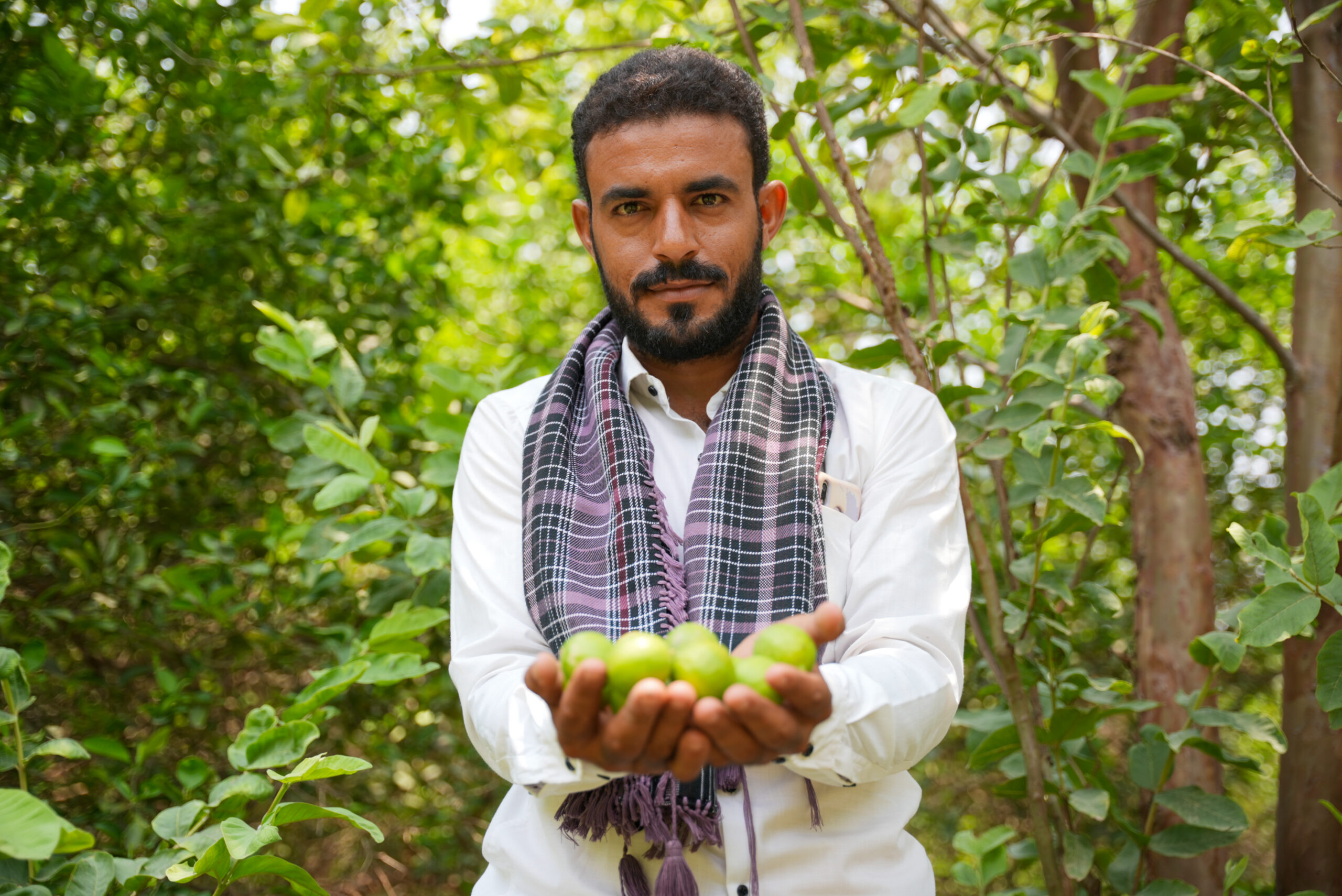
The variety known locally as “Baladi Lime” (globally recognized as the Key Lime or Citrus aurantiifolia) dominates domestic production. It outperforms imported varieties thanks to its small size, thin rind, exceptionally high acidity, and pungent aromatic flavor. Despite these competitive advantages and significant agricultural importance—where citrus cultivation accounts for approximately 13% of the total area planted with fruits—the value chain of this crop suffers from structural gaps that render it highly vulnerable to waste and value loss.
This article presents a rigorous analysis of these challenges, supported by official statistical indicators for the period (2017 – 2021). These statistics reveal a noticeable growth in production volume from 22,872 tons to 31,033 tons, accompanied by a gradual expansion in cultivated area from 2,275 to 2,586 hectares. Conversely, fundamental challenges emerge that hinder the optimal utilization of this growth. Most prominent is the low productivity (yield), which stagnates at an average of 12 tons per hectare—a relatively low figure compared to the global average of 20 to 30 tons/hectare. This indicates poor agricultural practices and the deterioration of aging trees. Furthermore, the crisis is exacerbated by severe post-harvest losses, which devour between 25% and 30% of total production.
The Volume of Lime Imports and Their Impact on the Local Market
Despite the increase in local production, the Yemeni market faces a challenge embodied by an import gap and the flooding of markets with imported limes, predominantly from the Horn of Africa and other regions. This casts a direct, negative shadow over the local farmer. The dimensions of this crisis are evident in the escalating import volumes, which reached 1,898 tons in 2022, only to surge in 2023 by an estimated 139% to reach 4,539 tons—an increase of 2,641 tons. Based on average global prices, the import bill for these quantities is estimated at approximately $1.8 to $4.5 million USD annually. This represents a continuous drain of hard currency for a crop that Yemen possesses the fundamental conditions and a high comparative advantage to produce and supply entirely domestically.
The coinciding entry of foreign products with local production seasons has led to a devastating economic impact, causing widespread commercial stagnation for the domestic product. In 2023, local lime prices plummeted by up to 50% compared to previous years; the price of a 20-kilo basket of green limes in certain areas of Al-Hudaydah dropped from approximately 6,000 Yemeni Riyals in the first half of 2022 to merely around 1,500 Riyals in 2023—a nominal amount that barely covers production costs.
As a result of these catastrophic losses incurred by farmers, protective trends and policies have recently emerged aimed at curbing the import bill and rescuing the national product. These directions rely on encouraging contract farming and working to regulate or ban the import of fruits, including limes, during peak local production seasons. This serves as a strategic step to protect farmers in the Tihama Plain and various agricultural regions from artificially induced market volatility.
Analysis of the Lime Value Chain Stages in Yemen
1. Agricultural Inputs
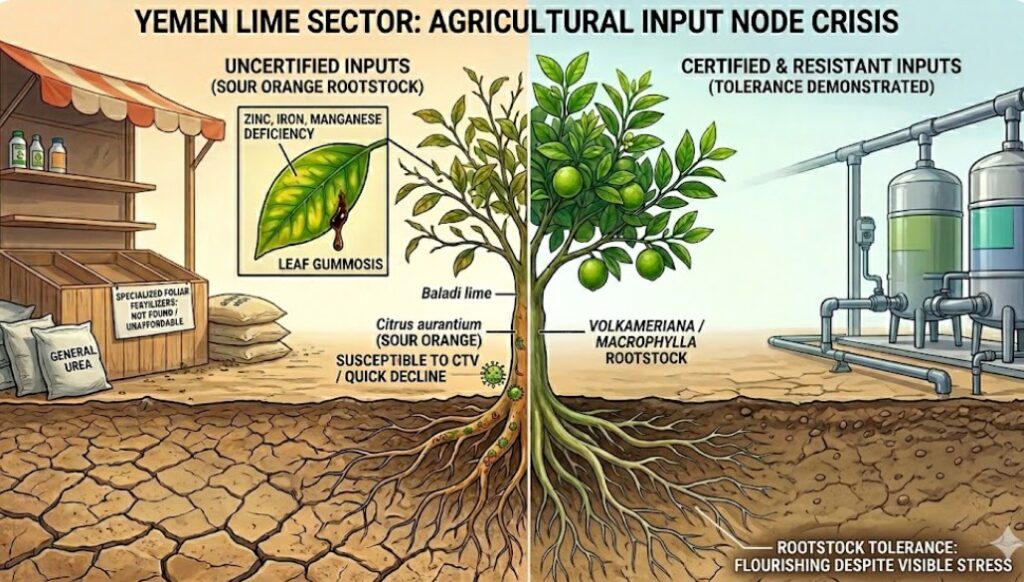
The agricultural inputs stage suffers from profound randomness that threatens the future of lime cultivation in Yemen. The cultivation of this crop still relies primarily on the use of un-grafted cuttings, or grafting onto unstudied local rootstocks. In this context, there is an almost total absence of certified rootstocks resistant to citrus diseases, such as Volkameriana or Macrophylla, which are characterized by their ability to tolerate soil salinity and drought. Instead, there is a reliance on the “Sour Orange” (Aurantium) rootstock, which is highly susceptible to the Citrus Tristeza Virus (CTV / Quick Decline).
Alongside the rootstock and scion crisis, the problem of specialized fertilizers emerges. The lime tree is highly sensitive to deficiencies in micro-elements such as zinc, iron, and manganese—a deficiency that clearly manifests as yellowing and gummosis on the leaves. Exacerbating this problem is the local market’s lack of specialized foliar fertilizers for citrus at affordable prices for the farmer, ultimately leading to the weakening of the tree, reduced productivity, and lower juice density in its fruits.
2. Production
Lime production in Yemen is concentrated in several governorates, undisputedly led by Hadramout with a production of 13,921 tons (representing roughly 45% of the total) across an area reaching 1,003 hectares. It is followed by Al-Hudaydah with 4,927 tons, benefiting from the warm environment of the Tihama valleys, and then Taiz with 2,400 tons. The governorates of Lahij and Al Bayda follow with comparable productions exceeding 1,500 tons each, alongside other important producing regions like Shabwah and Abyan. Limes are frequently planted as an intercrop with mango or date palm trees, or as boundary hedges for farms, making it a secondary crop in terms of care for some farmers.
This sector faces complex agricultural and environmental challenges that hinder it from reaching optimal productivity. Foremost among these is the spread of pests and diseases such as the Citrus Leaf Miner and the Whitefly, in addition to the lethal Gummosis disease, which spreads due to traditional flood irrigation and water coming into direct contact with tree trunks. Although limes consume less water than other crops like Qat, they are highly sensitive to drought; simultaneously, flood irrigation leads to elevated salinity and root asphyxiation.
These factors—alongside the aging of orchards that have surpassed their productive lifespan (20-30 years), arbitrary pruning, and an over-reliance on nitrogen fertilizers while neglecting micro-elements—explain why the average hectare yield remains at a dismal level of only 12 tons.
Proposed Solutions and Expected Strategic Impact
To boost productivity and address the yield gap, it is recommended to implement a package of agricultural procedures encompassing:
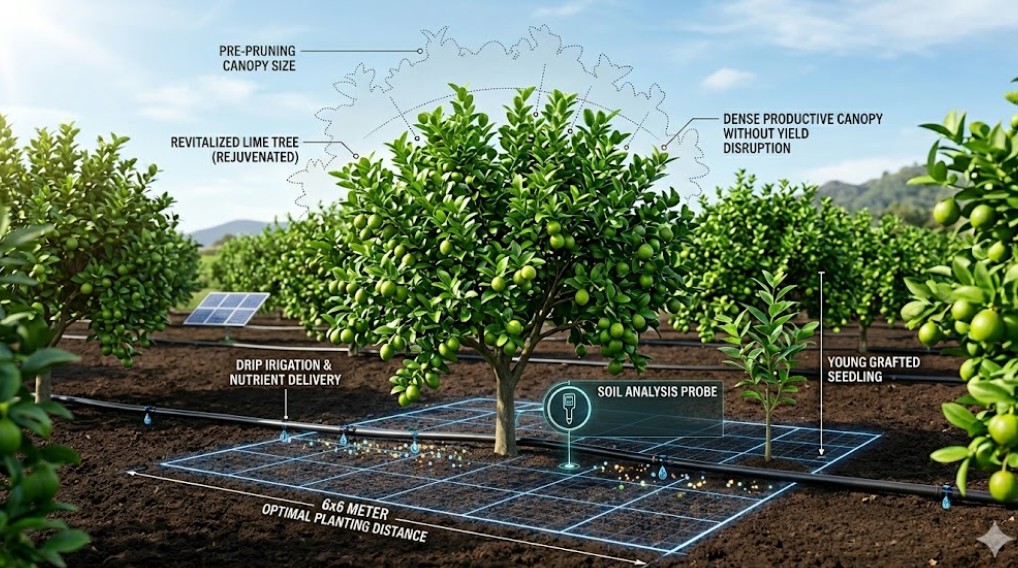
If this package is implemented, a radical impact is expected within a timeframe of 3 to 5 years, manifested in gradually raising the yield to reach the lower bound of the global average (18 tons/hectare). This improvement will leap total production from 31,000 tons to approximately 46,500 tons annually, achieving a net increase of 15,500 tons. This growth will lead to 100% self-sufficiency and the complete substitution of fresh imports, in addition to providing surplus quantities for export and local processing.
However, conversely, achieving this massive surplus (over 11,000 net tons after displacing imports) could represent a potential marketing disaster that might ruin farmers and lead to an unprecedented price collapse, unless the push to increase production coincides with the establishment of processing factories and sorting/export stations capable of absorbing the surplus and directing it toward manufacturing pathways.
3. Post-Harvest
The post-harvest link is considered the most loss-inducing stage within the lime value chain in Yemen. These losses begin with the manual harvesting method based on pulling/yanking, which tears the delicate rind of the Baladi lime. This tearing causes the release of essential oils from the rind, which in turn leads to the appearance of brown spots that accelerate the fruit’s rotting; proper harvesting requires the use of specific clippers to avoid this damage.
The problem is massively exacerbated during packaging, where Yemeni limes are packed into plastic woven sacks that completely block ventilation and trap heat inside. This thermal suffocation causes the green lime to turn a pale yellow and its rind to shrivel. Its susceptibility to rotting skyrockets, compounded by the absence of appropriate waxing and cooling technologies. The practice of citrus waxing—a necessary technique to preserve the fruit’s moisture—is entirely non-existent in Yemen.
Furthermore, a correct understanding of storage requirements is absent; limes do not require severe chilling or freezing. Rather, they require a moderately cool environment ranging between 10 to 12 degrees Celsius, with exceptionally high relative humidity ranging between 85% and 90% to prevent the rind from drying out.
4. Processing and Value Addition
The manufacturing link is the weakest in the Yemeni lime value chain, despite the Baladi lime variety being considered ideal for processing due to its exceedingly high acidity and robust aromatic flavor, which clearly surpasses many global varieties. The reality of this stage is characterized by an absence of genuine industrial investments and an over-reliance on imports to meet the local market’s need for lime derivatives.
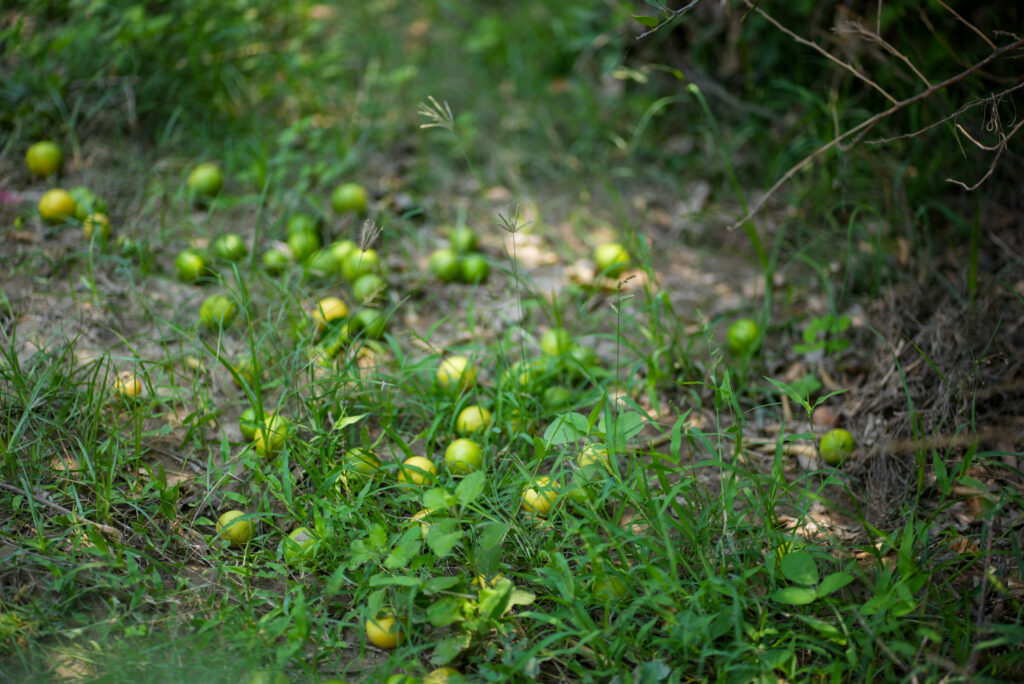
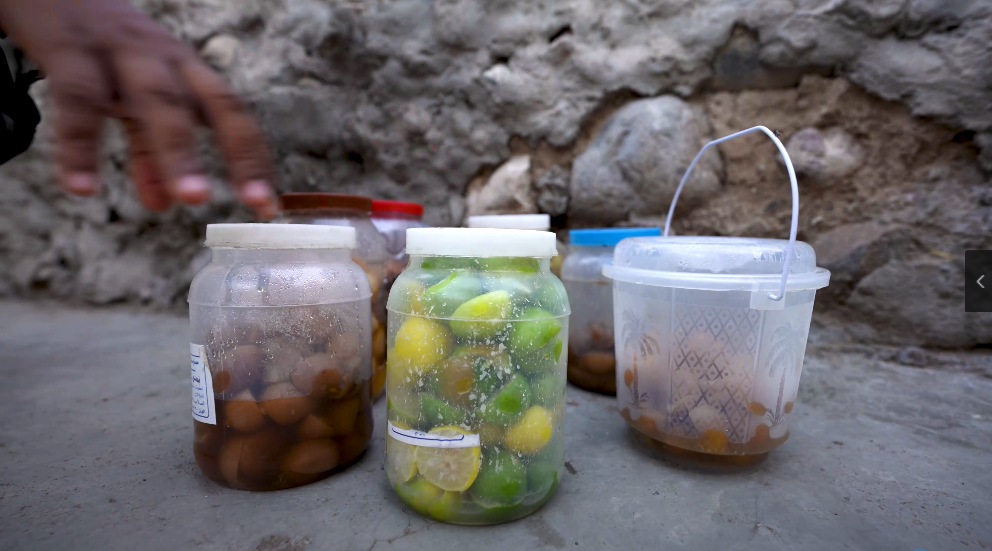
Regarding locally manufactured value-added products, processing industries are currently limited to traditional, manual efforts, yielding several modest products. At the forefront is the Dried Lime (Loomi or Black Lime) as the most prominent local processed product. Farmers resort to drying the fruits—often the small, surplus, or fallen ones—under direct sunlight on the ground for extended periods. This traditional method leads to the fruits being contaminated with dust and losing a significant portion of their flavor, rendering them non-compliant with international export standards in spice markets. This occurs amidst an almost total absence of scientific methods relying on rapid blanching and drying in enclosed solar dehydrators.
Additionally, Lime Pickle (Oshar or Moasfar) emerges as a product dominated by a home-based cottage industry, or manufactured via micro-enterprises within the informal sector to be consumed locally as an appetizer. This strips it of the necessary foundations to upgrade to the level of a large-scale commercial industry geared towards export markets.
5. Marketing and Distribution
The dynamics of the lime market in Yemen are characterized by sharp price volatility. While prices surge exceptionally during off-seasons or the month of Ramadan, they plummet drastically during peak production, threatening the farmer with catastrophic losses. The farmer’s suffering deepens due to the complex chain of intermediaries that swallows him; starting from the picker or guarantor (Dhamin) who buys the crop on the tree, passing through the auctioneer or agent (Muharrij) in central wholesale markets like the Ali Mohsen market in Sana’a, and ending with retailers.
On the flip side, export indicators and international competition reveal a massive market opportunity that remains sub-optimally exploited. While Yemen’s lime exports currently range between 600 to 1,000 tons annually (Wadi Hadramout alone recorded exports of roughly 635 tons in 2022), directed primarily to the Arab Gulf states, these neighboring countries rely almost entirely on importing hundreds of thousands of tons from distant nations like South Africa, Vietnam, and Brazil to meet their escalating demand.
The profound gap becomes evident when comparing our export volumes with the imports of those markets. The UAE imported over 142,000 tons in 2021, while Saudi Arabia’s import volume is estimated at approximately 123,000 tons annually according to 2024 estimates, and the Sultanate of Oman imports roughly 14,000 tons annually.
The significance of this export opportunity is magnified considering the value addition and pricing advantage the Yemeni (Baladi) lime enjoys in Gulf markets due to high preference for its unique characteristics of pungent aromatic flavor and high acidity. While the average global export price for a kilogram of fresh limes ranges between 0.8 to 1.2 USD, the sound, premium Yemeni lime (first grade) is sold to wholesalers in the Gulf at an average price ranging between 1.5 to 2.5 USD per kilogram, and may even exceed 3 USD during peak consumption seasons.
This high price represents a massive economic incentive to direct efforts and investments toward developing modern sorting and packing stations. This will enable Yemen to penetrate these lucrative regional markets and spare the local farmer the crises of stagnation and depressed prices during seasons of abundant production.
Stakeholders Mapping
To understand the dynamics of the lime sector in Yemen, one must trace the sequence of key players in the chain, in addition to evaluating the roles of supporting and regulatory entities that drive this sector’s rise and fall.
First: The Value Chain Map
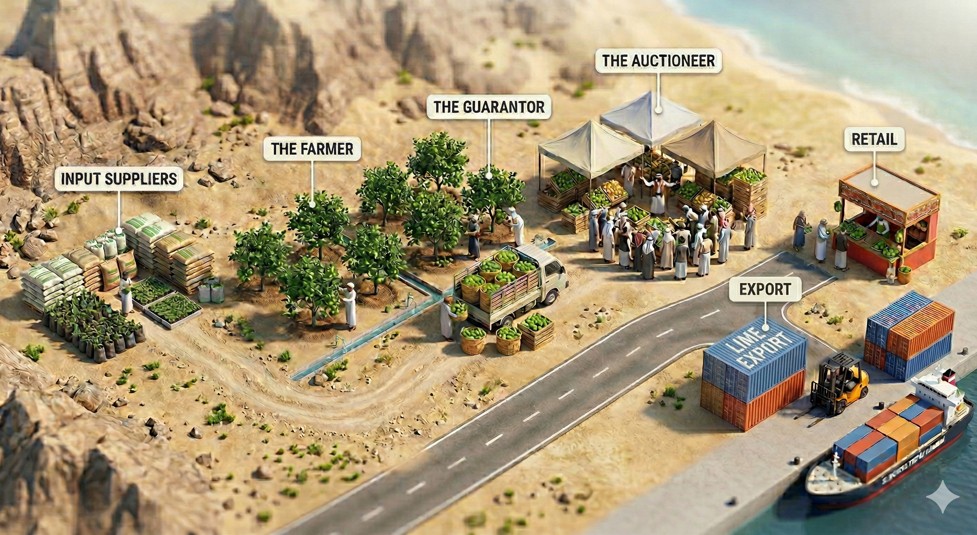
The lime crop in Yemen traverses a traditional path characterized by multiple Key Players. Its simplified map can be drawn as follows:
Input Suppliers (seeds, fertilizers, unregulated nurseries) ➔ The Farmer (production and care stage) ➔ The Picker/Guarantor (intermediary buying the crop on the tree and harvesting) ➔ The Auctioneer/Agent (in central wholesale markets) ➔ Retailers / Micro-processors ➔ Final Consumer / Exporter.
Second: Stakeholders Matrix
The following table outlines the acting and supporting entities, the importance of their role in the sector, current gaps hindering development, and proposals to activate their roles:
| Stakeholder Entity | Role Importance in the Sector | Current Gaps | Development Proposals |
| Ministry of Agriculture and Irrigation | Formulating regulatory policies and drafting development plans for the sector. | Weak operational budgets, shrinking field extension staff. | Activating “Farmer Field Schools (FFS)” specialized in citrus. |
| Agricultural Research Centers | Studying epidemiological pests, conducting agricultural research, deducing and cataloging citrus rootstocks suitable for the Yemeni environment, and defining technical production standards. | Almost total halt of applied research due to a lack of funding; failure to link research outputs with the farmer’s daily needs. | Directing specific funding to a project for “Propagating drought and salinity-resistant citrus rootstocks” and distributing them as mother plants to nurseries. Utilizing social media to communicate with farmers. |
| Private Sector | Providing production inputs and investing in marketing and export infrastructure. | Importing generic fertilizers lacking critical micro-elements for limes. High prices of provided agricultural production inputs. Weak investor appetite for local value-addition industries. | Providing tax exemptions for investing in value-addition projects. Investing in the local manufacturing of agricultural inputs (like recycling waste to produce compost). |
| International Orgs and Donors (NGOs) | Funding rural development projects, building farmer capacities, and introducing modern technologies. | Over-focus on emergency food security projects (food baskets), and limited support for agricultural value chain projects—especially regarding interventions necessary to integrate farmers into international markets. | Directing grants toward building “infrastructure,” such as establishing sorting and packing stations, Zero-Energy Evaporative Cool Chambers, and upgrading laboratories to become internationally accredited. |
| Agricultural Cooperatives | Unifying farmers’ efforts, bulk purchasing of inputs, breaking broker monopolies, and collective crop selling to maximize profits. | Current entities are virtually paralyzed, lack institutional and financial management, and do not enjoy farmers’ trust in certain regions. | Establishing “Specialized Citrus Producers’ Cooperatives,” training cooperative cadres, and having competent authorities review agricultural cooperative policies to enact laws ensuring financial and administrative transparency while activating the principle of oversight. |
Comprehensive Challenges and Gaps in the Lime Value Chain in Yemen
Based on the baseline analysis of all chain links, the most prominent structural challenges hindering the growth and competitiveness of the lime sector can be summarized in three main axes:
Strategic Interventions to Upgrade the Chain
To confront the structural challenges plaguing the lime sector in Yemen and transform them into genuine developmental opportunities, there is an urgent need to adopt a package of interconnected strategic interventions targeting every link of the value chain.
On the Production and Inputs front, focus must be placed on field development by launching a national program to establish covered nurseries producing disease-free seedlings grafted onto rootstocks resistant to gummosis and salinity. This must run in parallel with activating Farmer Field Schools to train them in rejuvenation pruning practices for aged trees and drip fertigation systems to boost yields.
To overcome the crisis of waste and value loss in the post-harvest stage, it is imperative to develop logistical infrastructure by encouraging the private sector and organizations to invest in integrated packing and sorting stations that wash the limes, wax them to preserve juice, grade them mechanically, and pack them in ventilated cartons instead of destructive sacks. In this context, the adoption of Zero-Energy Evaporative Cool Chambers represents an innovative and highly economically feasible solution for the rural environment. These chambers are built locally at almost zero cost using double-brick walls stuffed with wet sand, providing natural cooling between 10 to 15 degrees Celsius with very high humidity that prevents rind shriveling without any electricity consumption. This allows the farmer to store his crop and avoid forced selling at a loss during times of oversupply.
On the Marketing and Institutional level, to ensure sector regulation, genuine support is required for agricultural cooperatives to activate their role in enabling farmers to bypass the complex chain of intermediaries, provide inputs at wholesale prices, and enhance their collective bargaining power. This organization must be accompanied by encouraging Contract Farming to link farmers with processing plants and wholesalers via forward contracts that guarantee the absorption of surplus production. This is alongside continuing to activate protective government policies aimed at restricting the import of foreign limes during peak local production seasons.
Proposed Strategic Roadmap for Upgrading the Value Chain
Based on the analysis of chain gaps, the volume of local and regional demand, and the current state of the market environment, alongside the core infrastructure, inputs, and market support services in Yemen, a strategic roadmap can be drawn to prioritize interventions ensuring the highest economic return with the lowest risk.
In the Short and Medium Term, quick-win pathways emerge by focusing on raising productive efficiency by directing extension support to implement a package of corrective agriculture programs (gradual replacement, improved fertilization practices, Rejuvenation pruning, and spacing management) to increase the average yield from 12 to 18 tons per hectare. This initial increase is directed to completely substitute fresh imports, thereby protecting the Yemeni farmer and halting the drain of millions of dollars annually. Once local self-sufficiency is achieved, the high-quality surplus from the first and second grades is directed to penetrate regional markets and export fresh fruits to neighboring Gulf states, which collectively import over 279,000 tons annually. This pathway provides rapid cash flows via the establishment of simple sorting and packing stations, which are far less costly than massive factories.
In the Long Term, entering the processing and value-addition sector represents a necessary and inevitable safety valve to deal with third and fourth-grade fruits that the export market rejects, and to avoid price collapses during extreme peak seasons. However, the success of this industrial investment is conditionally linked to achieving a massive increase in total production volume to reach a structural strategic surplus. This guarantees the provision of raw materials at low, sustainable industrial prices, enabling local products to compete with imports and avoiding the halting of production lines.
Within this industrial pathway, the primary processing of Black Lime (Loomi) emerges by improving modern solar drying techniques; the kilogram is sold regionally at an average of 3 to 6 USD in wholesale markets and reaches between 10 and 15 USD in retail. This is accompanied by encouraging investment in advanced processing to produce lime juice concentrate at an estimated local cost of 1.5 to 2.5 USD per kilogram—compared to an average global import price ranging between 4 to 8 USD—providing local juice factories with a cheaper, higher-quality alternative. This level also includes extracting essential lime oil as a byproduct using cold-press technology, with a production cost of roughly 35 USD per kilogram. It sells in the global wholesale market at prices ranging between 50 to 90 USD, and may reach between 150 and 300 USD in retail, making it a highly lucrative strategic product targeted for export to global perfume and pharmaceutical companies.
Conclusion
The lime sector in Yemen represents a strategic developmental and investment opportunity that transcends the traditional agricultural scope. The transition from an arbitrary production pattern to an “integrated, market-oriented value chain” is the guarantor of halting the drain of hard currency via import substitution, and securing new cash flows through exporting fresh fruits to Gulf markets hungry for this distinctive variety.
Achieving this vision necessitates an actual transition from the diagnosis phase to implementation, through the concerted efforts of government entities, the private sector, and donor organizations to fund basic infrastructure (such as resistant rootstock nurseries, sorting and packing stations, and evaporative cool chambers). Ultimately, investment directed toward the “Baladi Lime” sector is a sustainable investment in food security, a direct improvement of the livelihoods of thousands of Yemeni farmers, and a repositioning of the Yemeni product on the regional agricultural map.
References and Citations
This article relied on data derived from the following statistical and research sources: