Join us
شارك معنا
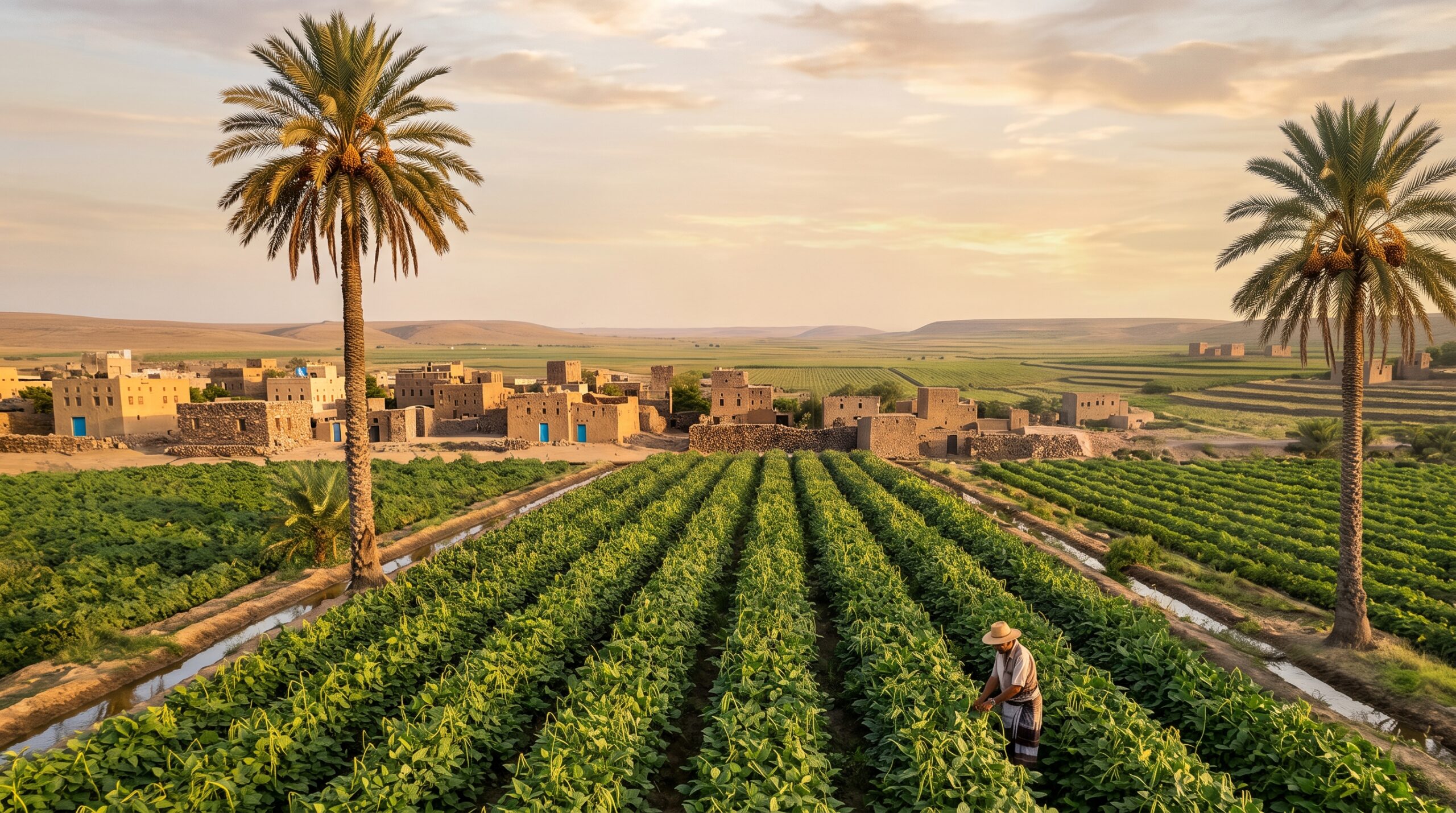
This report provides a comprehensive and in-depth analysis of the cowpea value chain (locally known as “Dajr”) in Yemen, highlighting its current status, structural challenges, and latent investment opportunities. Official statistics from 2021 indicate that Yemen’s cowpea production reached 80,078 tons, with the vast majority (78.2%) concentrated in the Tihama region—specifically Al-Hudaydah Governorate—rendering it the true “cowpea basket” of Yemen.
Despite this substantial production, the domestic market still suffers from a consumption gap estimated at approximately 25,000 tons annually, which is covered through imports at an economic cost of around $25 million. The primary cause of this gap lies in severe post-harvest losses; storage pests (weevils) and poor handling destroy between 25% and 35% of the crop, forcing farmers into distress selling at low prices to avoid total loss.
The report concludes that closing this gap and achieving self-sufficiency does not necessarily require expanding the cultivated area, but rather a strategic intervention to correct the trajectory of the value chain. It proposes a package of interventions supported by financing models, most notably:
Implementing these interventions would recover losses, increase productivity by up to an additional 32,000 tons, and create sustainable value-added benefits for farmers and the national economy.
The origins of the cowpea (Vigna unguiculata) trace back to the African continent, specifically West Africa, where it was domesticated thousands of years ago before spreading to Asia and the Americas. Its global economic importance lies in its role as the “meat of the poor,” as its seeds contain a protein content ranging from 20% to 25%. Global production is estimated at around 7 to 9 million tons annually, mostly concentrated in Sub-Saharan Africa. The economic importance of the crop is highlighted by its exceptional ability to fix atmospheric nitrogen, which reduces fertilizer costs, alongside its high tolerance for drought and heat stress.
In Yemen, cowpea is locally known as “Dajr,” a legume crop deeply rooted in ancient Yemeni agricultural systems, particularly in rainfed agriculture. The Yemeni product (both Tihama and highland varieties) is characterized by its unique genetic adaptation to harsh local climates and its rich flavor, which local consumers prefer over imported varieties. “Dajr” represents a dual pillar in the Yemeni agricultural economy: it is an essential food security crop for rural households and a significant source of cash income, in addition to its crop residues (haulms) being among the finest and highest-priced types of animal fodder.
Cowpea production in Yemen is experiencing strong and continuous upward growth; total domestic production surged from 46,891 tons in 2017 to 80,078 tons in 2021. This increase was accompanied by a steady expansion in the cultivated area from 19,657 hectares to 29,881 hectares over the same period.
The geographical distribution of production is characterized by a highly dominant concentration in the western coastal strip (Tihama region). Al-Hudaydah Governorate leads production in absolute terms, accounting for approximately 78.2% of the total national production on its own, with 62,623 tons (according to 2021 data) across a cultivated area of 21,858 hectares. Hajjah Governorate ranks second with a production of 5,061 tons. In the mountainous highlands, Amran Governorate leads with 3,643 tons, followed by Raymah with 1,907 tons, and Al-Mahwit with 1,863 tons, while production gradually diminishes in the central and southern governorates.
The following table reviews the prominent local varieties, their characteristics, and their estimated share of production:
| Variety (Local Name) | Main Cultivation Areas | Estimated Share of Production | Distinctive Characteristics (Pros) | Challenges (Cons) |
| Tihami Dajr (White/Light Brown) | Al-Hudaydah, Hajjah (Wadis Zabid, Rima’, Maur) | 80% – 85% | Medium to large grain size; fast-cooking; high yield per hectare; excellent, dense haulms for fodder; tolerates high temperatures (above 35°C). | Highly susceptible to weevil infestation during storage; requires heavy spate irrigation during flowering periods. |
| Highland Dajr (Red/Mottled) | Amran, Al-Mahwit, Raymah, Sana’a | 10% – 15% | Very strong, concentrated flavor; higher drought tolerance compared to the Tihami variety; thicker seed coat providing relative (moderate) resistance to storage pests. | Small grain size; lower yield per hectare than the Tihami variety; takes longer to cook. |
| Black Dajr (Rare/Forage) | Edges of Tihama and some arid areas | Less than 5% | Exceptional drought resistance; rapid vegetative growth. | Unpreferred for direct human consumption due to its bitter taste; primarily used for grazing or green manuring. |
Regarding the yield per hectare, official data for 2021 indicates that the average yield reached 2.68 tons/hectare—a high rate that reflects the superior productive efficiency of the Tihama valleys when spate irrigation water is available.
Despite this substantial domestic production of 80,078 tons, the gap between supply and demand persists. Due to a “data gap” in official statistics resulting from the failure to segregate cowpea imports from other legumes, logical estimates of local consumption relative to population size indicate that the annual consumption gap for the crop is estimated at around 25,000 tons. As a consequence of this significant deficit, export volumes are virtually non-existent (approaching 0%), as the Yemeni market completely absorbs domestic production in an effort to bridge this ongoing shortfall.
The initiation of the cowpea (Dajr) value chain in Yemen is constrained by a notable cost structure; manual labor and land preparation (such as tractor plowing during seasonal spate flows) account for the largest share of total expenditures at 60%. Conversely, seed inputs do not exceed 10% to 15% of the total cost, as Yemeni farmers in the Tihama valleys rely almost completely (up to 95%) on “saved seeds” from the previous season’s harvest. While this reliance eliminates the cost of purchasing seeds, it compromises production efficiency and exposes the crop to the risk of varietal degradation. Long-term reliance on saved seeds without “field selection” processes has led to genetic mixing, resulting in a gradual decline and degradation in the grain size of the Tihami cowpea.
In terms of fertilizers, the use of chemical inputs is very rare because cowpeas are biologically dynamic plants that fix atmospheric nitrogen into the soil autonomously. However, the greatest risk lies in the cost of “chemical pesticides” required to control aphids and pod borers during the flowering stage—inputs subject to monopoly pricing by specific suppliers in Al-Hudaydah markets. The indiscriminate use of these chemicals, or reliance on smuggled pesticides, eradicates beneficial insects and pollinators. This often leads to fruit-set failure and flower dropping, thereby drastically reducing crop yields. On average, the estimated cost of essential inputs (pesticides and mechanized plowing) ranges from $150 to $250 per hectare per season.
Cowpea cultivation in Tihama (Al-Hudaydah and Hajjah) is not classified as organized, irrigated agriculture; rather, it relies primarily on a “spate irrigation” system. Farmers sow cowpea seeds immediately after floodwaters recede from the land. This practice is highly critical and demands precise timing; any delay exposes the plants to water stress before the pods can fully mature.
Several critical constraints shape productivity outcomes, most notably: the continuous fluctuation in spate flow timings, pest outbreaks during the flowering stage, and the forced recourse of some farmers to early “overgrazing”—selling the crop as green fodder if rains are delayed and the pod-setting stage fails. According to official quantitative indicators estimated for 2021, the actual average productivity stands at 2.68 tons/hectare (including the weight of dry pods), while the estimated production cost per kilogram ranges between $0.40 and $0.60. This low efficiency is partly attributed to weak technological modernization, as the adoption rate of modern technologies—such as virus-resistant hybrid seeds and mechanized harvesting—is less than 2%.
The post-harvest handling stage represents the weakest and most destructive link in the value chain, often described as a “silent disaster.” The dilemma begins with traditional threshing methods: the crop is harvested manually and the pods are left to dry under direct sunlight, after which they are beaten with sticks or randomly trampled by tractors. This causes grain cracking, destroying their marketability as premium-grade products.
The crisis escalates inside storage facilities due to storage pests; the cowpea weevil (Callosobruchus maculatus) decimates the crop within just two to three months of storage. This damage occurs because farmers store the harvest in woven plastic sacks (old sugar and flour bags) that allow air and insects to penetrate easily. To mitigate this infestation, some unfortunately resort to the indiscriminate use of toxic fumigation tablets (aluminum phosphide, locally known as the “gas pill”) inside residential homes, posing severe health hazards to inhabitants. Consequently, quantitative losses due to weevils and breakage are estimated at 25% to 35% of the stored crop. This also inflicts heavy financial losses: “weevil-damaged” (perforated) cowpeas lose between 50% and 70% of their market value, forcing farmers to sell their harvest as cheap animal feed instead of directing it toward human consumption.
On the industrial front, 100% of the cowpea crop is currently sold as raw, dry grains without any processing. Given Al-Hudaydah Governorate’s production volume of 62,000 tons, the economic viability of directing a portion of this output toward automated sorting and modern vacuum packaging is exceptionally high. This shift would instantly halt storage losses, extend product shelf life, and create value-added products that meet the demands of urban consumers. However, this investment ambition faces major hurdles, including the total absence of automated sorting and cleaning lines in Al-Hudaydah’s wholesale markets, persistent power outages, and limited financing directed toward modern packaging technologies.
In the context of product diversification, utilizing by-products emerges as a promising investment opportunity:
The following table outlines the prominent proposed investment products and opportunities for achieving value addition in cowpea:
| Value-Added Product | Estimated Production Cost (per kg) | Raw Material Required to Produce 1 kg of Finished Product | Estimated Global Production Volume of the Product | Average Estimated Global Price (per kg) |
| Canned Cowpeas (Stewed or Boiled) | $0.8 – $1.2 | 0.4 kg of dry grains (as they absorb water and expand during cooking) | ~ 400,000 tons annually | $1.5 – $2.5 |
| Frozen Green Cowpea Pods | $0.6 – $1.0 | 1.2 kg of fresh green pods (accounting for losses during trimming and cleaning) | ~ 250,000 tons annually | $1.5 – $3.0 |
| Cowpea Flour (Gluten-Free) | $1.0 – $1.5 | 1.15 kg of dry grains (to compensate for losses from seed de-hulling) | ~ 150,000 tons annually (emerging market) | $2.5 – $4.0 |
| Cowpea Protein Isolate | $3.5 – $5.0 | 4.5 – 5.0 kg of dry grains (given that the protein content per grain is 20% – 25%) | ~ 50,000 tons annually (advanced technology) | $8.0 – $12.0 |
| Concentrated Feed Pellets (from husks & haulms) | $0.15 – $0.25 | 1.1 kg of dry husks and haulms (thermally compressed) | Millions of tons (as a general feed market) | $0.40 – $0.60 |
The structural imbalances of the preceding stages are clearly reflected in the marketing and sales phase. Farmers in both the Tihama coastal plain and the highlands remain the weakest link in the chain, falling victim to “distress selling” immediately after harvest. This action is driven by pressing constraints, primarily the urgent need to settle debts from previous seasons and the desire to avoid devastating weevil infestations in the absence of safe storage facilities. Consequently, wholesalers exploit this window to purchase the crop at depressed prices, store it, and reintroduce it into major central markets—such as Sana’a, Aden, and Taiz—during off-season periods at doubled prices, capitalizing on product scarcity.
Market access channels suffer from low efficiency; the supply chain is classified as long, complex, and highly intermediated. This occurs amid a total absence of cooperative associations that could aggregate, market, and negotiate on behalf of cowpea farmers to protect them from exploitation. This negative dynamic is reflected in the sector’s estimated quantitative indicators: the producer’s (farmer’s) share of the final consumer price does not exceed 35% to 45%, while the vast majority of profits flow to middlemen and traders. Furthermore, the price gap widens sharply, with prices fluctuating between 100% and 150% between the harvest season (characterized by abundance and low prices due to distress sales) and the scarcity season (characterized by monopolies and high prices).
To understand the dynamics of the cowpea (Dajr) sector and identify effective points of intervention, actors within the value chain are categorized into two groups: Core Actors (who physically own or handle the crop) and Stakeholders (enablers and service providers).
| Core Actor / Entity | Key Role in the Value Chain | Deficiencies and Challenges | Proposed Development Interventions |
| Agricultural Input Suppliers | Provision of pesticides, fertilizers, and packaging bags. They control the primary cost of production. | Importation of non-specific general pesticides; marketing of pesticides harmful to pollinators (bees); absence of hermetic storage bags (e.g., PICS bags). | Introduction and commercial marketing of hermetic storage bag technology; provision of safe, bio-pesticide alternatives. |
| Farmers (Tihama and Highlands) | The cornerstone of the chain; responsible for cultivation, manual harvesting, and primary drying. | Use of destructive threshing methods that crack the grains; financial vulnerability leading to post-harvest distress sales at a loss; arbitrary seed selection. | Training on field selection of seeds; adoption of improved threshing techniques; participation in cooperative entities for crop aggregation. |
| Middlemen and Aggregators (Village Level) | Aggregating the harvest from small, scattered holdings; providing immediate (though exploitative) cash liquidity to farmers. | Exploiting the farmers’ urgent need for liquidity at harvest time to enforce depressed prices; poor transport and handling practices that increase spoilage. | Formally integrating them as direct supply agents (contractors) for packaging and processing facilities; training them in primary sorting. |
| Wholesalers (Al-Hudaydah, Bajil, Sana’a) | Strategic storage; controlling supply channels and distributing the crop to major central markets. | Storage in substandard woven sacks; indiscriminate and hazardous use of toxic fumigation gasses (“gas pills”); market monopolization and artificial price manipulation. | Investing in modern silos and warehouses; establishing automated sorting and vacuum-packaging lines to enhance product quality and minimize spoilage. |
| Retailers and Central Markets | The final point of contact with consumers; presenting the product in its end-consumer form. | Open-air display of the product, which facilitates the transmission of weevil infestations between sound and infected batches; lack of quality grading. | Demanding automatically sorted and packed products from wholesalers; improving the display and storage environment within retail outlets. |
| Stakeholder / Entity | Key Role in the Value Chain | Deficiencies and Challenges | Proposed Development Interventions |
| Ministry of Agriculture and Agricultural Extension | Policy formulation; protecting entry points from imported pests; providing field-level guidance and extension services to farmers. | Sharp decline in field visits to the Tihama valleys; absence of awareness campaigns regarding the hazards of indiscriminate fumigation; shortage of specialized personnel. | Activating intensive extension campaigns on Integrated Pest Management (IPM) and safe storage technologies. |
| Agricultural Research Stations (e.g., El-Kadan Station) | Breeding and improving local varieties to achieve higher yields and greater tolerance to drought and pests. | A disconnect between academic research and the actual needs of farmers; weak operational budgets to execute pure seed multiplication programs. | Launching a national program for the multiplication and purification of the “Tihami Dajr” variety, distributing it as foundation seed to farmers. |
| Microfinance Institutions and Banks | Providing liquidity for inputs and financing post-harvest technology infrastructure. | Reluctance to finance rainfed agricultural sectors due to high climate-related risks; lack of financial products tailored specifically to agricultural value chains. | Designing and launching financial products secured by the “warehouse receipt system”; offering in-kind loans (sorting equipment, hermetic storage drums). |
| Meteorological and Early Warning Centers | Providing accurate data regarding rainfall timings and spate flows in the valleys. | Poor and untimely delivery of climate alerts to smallholder farmers who lack modern communication tools. | Linking farmers to free SMS alert networks that specify optimal sowing windows to avoid crop water stress. |
| Industrial Sector and Investors | Absorbing surpluses, driving import substitution, and creating high value addition (e.g., cowpea canning or animal feed manufacturing). | Total absence of industrial investments in the cowpea processing sector; apprehension regarding energy and electricity challenges in Tihama. | Directing capital toward establishing local canning factories and setting up production units for feed pellets derived from crop husks. |
To address the diagnosed structural bottlenecks within the value chain, we recommend the following integrated package of strategic interventions. To ensure operational feasibility, each intervention is mapped to a proposed financing model, an estimated cost, and an appropriate execution timeframe:
| # | Proposed Strategic Intervention | Proposed Financing Model | Estimated Cost | Implementation Timeframe |
| 1 | Integrated Field Pest Management (IPM) | Development and agricultural grants (international organizations such as FAO, aid agencies). | $500,000 – $1,000,000 (extension campaigns and bio-alternative provision) | 1 – 2 years (Short-term / Urgent) |
| 2 | Spate Water Harvesting and Early Warning Systems | Climate finance (Global Climate Funds, World Bank). | $2,000,000 – $5,000,000 (engineering infrastructure and meteorological systems) | 2 – 5 years (Medium to Long-term) |
| 3 | Safe and Hermetic Storage Project | Blended Finance: Grants for awareness campaigns + subsidized microfinance for bag purchasing. | $300,000 – $600,000 (supplying millions of bags at subsidized rates) | 6 – 12 months (Urgent) |
| 4 | Cooperative Entities and the “Warehouse Receipt System” | Agricultural development funds + commercial bank guarantees to establish a revolving fund for financing. | $1,000,000 – $1,500,000 (capital for inventory-backed lending) | 1 – 3 years (Medium-term) |
| 5 | Field Seed Selection | Government funding (agricultural research) supported by technical and community grants. | $100,000 – $200,000 (research programs and demonstration plots) | 1 – 2 cropping seasons (Short-term) |
| 6 | Establishing Collection and Sorting Hubs | Public-Private Partnerships (PPP) or venture/commercial capital investment. | $500,000 – $1,500,000 (to establish a network of sorting centers) | 1 – 2 years (Medium-term) |
| 7 | Investment in Concentrated Feed Manufacturing | Private Equity and commercial loans (local investors). | $200,000 – $800,000 (depending on the capacity of the pelleting line) | 1 – 2 years (Medium-term) |
| 8 | Localizing Automated Sorting and Packaging Technologies | Private Investment supported by commercial banks (industrial enterprises). | $1,500,000 – $3,000,000 (advanced sorting and vacuum-packaging machinery) | 2 – 3 years (Medium-term) |
Mathematical estimates indicate that the expected quantitative impact of implementing this integrated package of agricultural and technical measures—aligned with the proposed financing matrix—will be decisive in transforming the sector. A substantial overall increase in domestic production will be realized via two primary pathways, without requiring horizontal expansion or increasing the currently cultivated area:
By consolidating the outcomes of these two pathways, the net estimated increase available in central and local markets will range between 28,000 and 32,000 tons annually. This added value carries profound food security and macroeconomic implications; it is entirely sufficient to completely bridge the nation’s estimated domestic consumption gap (of 25,000 tons), shifting the cowpea sector from a state of deficit and distress selling to true, sustainable self-sufficiency.
Commercial analysis of the cowpea (Dajr) sector in Yemen reveals a distinct deficit in the trade balance for this vital crop; export figures stand at zero, as current domestic production is insufficient to meet the basic demands of the Yemeni market. Due to the absence of a separate customs classification that isolates cowpea imports from other legumes at official ports of entry, the following logical estimation matrix has been constructed based on the 25,000-ton consumption gap and prevailing global market prices per ton:
| Type of Imported Product to Bridge the Gap | Estimated Imported Quantity (Tons/Year) | Average Estimated Import Cost per Ton | Total Estimated Cost (USD/Year) |
| Dry Cowpea Grains (Raw) | 25,000 tons | $1,000 | $25,000,000 |
| Estimated Total | 25,000 tons | – | $25,000,000 |
When comparing product pricing, a striking marketing paradox emerges: despite the influx of foreign imports, local Yemeni “Dajr” commands a premium in retail markets, selling at a higher price—ranging between $1.5 and $2.5 more per kilogram—than the imported alternative. This positive price differential is driven by the definitive preference of Yemeni consumers for the distinct flavor and superior quality of local varieties, establishing a strong competitive advantage for the domestic product if it is properly protected and developed.
The presence of a massive production volume of 62,000 tons geographically concentrated within a single governorate (Al-Hudaydah) offers an ideal and highly viable economic environment for establishing automated sorting centers and modern vacuum-packaging facilities, alongside launching promising industrial lines such as canning. Channeling local cowpea production into processing and packaging under strict quality standards will simultaneously achieve three strategic objectives:
Ultimately, this comprehensive analysis demonstrates that the cowpea (Dajr) sector in Yemen is not merely a traditional agricultural crop aimed at fulfilling the subsistence needs of smallholders; rather, it represents an unexploited agricultural and economic goldmine with exceptional latent potential. The heavy concentration of production in the Tihama region—exceeding 80,000 tons—coupled with the massive biomass available from its industrial by-products, underscores the sector’s readiness for serious, economically viable investments.
Successfully elevating this sector depends on transitioning from fragmented, traditional harvesting and storage practices toward an institutional framework built on the recommended strategic interventions. Synergizing the efforts of the government, the private sector, and development organizations to direct necessary funding toward hermetic storage technologies, automated sorting hubs, and value-added processing lines will secure substantial rewards. It will allow Yemen not only to halt the $25 million annual drain on imports but also to improve the livelihoods of thousands of rural families, creating a progressive agricultural development model that can be replicated across other crop sectors.
References and Sources