Join us
شارك معنا
[wpgmza id=”1″]
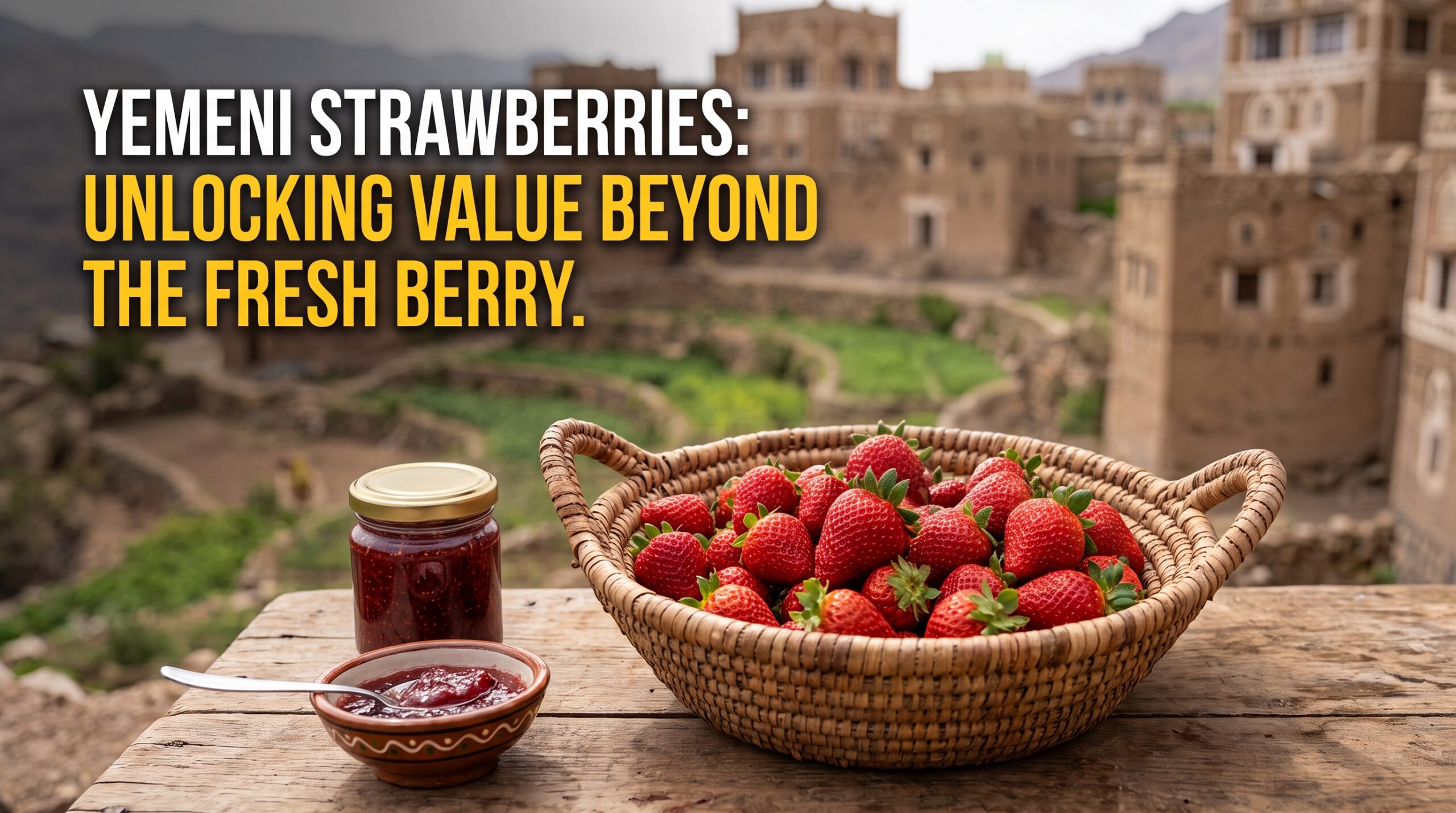
Strawberry cultivation in the Yemeni highlands represents one of the most successful narratives of modern agricultural transformation post-2015. It serves as a highly profitable cash crop alternative to Qat cultivation and a primary driver for the employment of rural women and youth. The current national production for the year 2026 is estimated at 3,800 to 4,500 tons annually, primarily concentrated in the Sanhan district of the Sana’a governorate, followed by the plateaus of Dhamar, Saada, and Taiz.
Although the fresh strawberry sector has achieved 100% complete self-sufficiency and the importation of fresh produce has completely ceased, the value chain continues to suffer from severe structural bottlenecks. These limitations restrict economic efficiency and prevent access to export markets or industrial networking. The most prominent challenges include: viral and genetic degradation of locally propagated seedlings, indiscriminate spraying of chemical pesticides to combat the red spider mite without adhering to Pre-Harvest Intervals (PHI), the absence of a cold chain, and primitive packaging practices using “plastic juice cups.” Coupled with rugged mountain roads, these packaging methods cause the crushing and spoilage of over 30% of the crop.
To overcome these bottlenecks, this study proposes three integrated strategic interventions specifically tailored to the Yemeni context:
Mathematical and economic indicators have proven the exceptional feasibility of these interventions. They are expected to increase the healthy, marketable national supply by 135.6%. Furthermore, a detailed feasibility study for establishing a local strawberry jam production facility (with a capacity of 1 ton/day) demonstrated massive investment returns. It offsets the capital expenditure (CAPEX) of $94,500 within just 6.5 months of operation, with an Internal Rate of Return (IRR) exceeding 180%.
Transitioning Yemen’s strawberry sector from its current disorganized service and marketing state into an integrated agricultural and industrial value chain will directly contribute to supporting the national economy, substituting imports, and raising the income of smallholder farmers, making it an inspiring model for sustainable development in the country.
The modern strawberry (Scientific name: Fragaria × ananassa) originated from a hybridization that occurred in France (Brittany region) in the 18th century between two wild varieties imported from North America and Chile. Since then, this fruit has spread globally to become one of the most economically valuable soft fruits (Berries).
Global strawberry production has surpassed 9 million metric tons annually, with a global market value exceeding $16 billion. China, the United States of America, Mexico, and Egypt top the list of the most producing and exporting countries for strawberries (both fresh and frozen).
Strawberry cultivation in Yemen is considered a relatively modern and promising horticultural activity, having gradually expanded after 2015 as a highly profitable cash alternative to certain traditional and imported crops. This expansion was encouraged by a significant rise in import costs and shipping difficulties, prompting local farmers to adopt domestic cultivation under greenhouses and in open fields across the highlands.
Yemeni (“Baladi”) strawberries possess several characteristics that give them a local advantage over previously imported counterparts (such as Egyptian strawberries):
Despite its recent introduction, the strawberry is gaining ascending economic status. As a labor-intensive crop, it provides continuous employment opportunities for youth and women in rural areas (in picking, sorting, and packing operations). It also represents an excellent, competitive alternative to Qat cultivation in certain valleys due to its high financial return per square meter and its superior efficiency in utilizing modern irrigation techniques amidst water scarcity.
Due to the absence of precise official statistics for this relatively new crop, our field estimates—based on agricultural association surveys for 2026—indicate that Yemen’s total strawberry production ranges between 3,800 and 4,500 tons annually, with rapid growth in the number of greenhouses dedicated to the crop.
Major production areas are concentrated in the central and northern highlands, which feature moderate and cold climates:
Strawberries in Yemen are cultivated relying on imported horticultural seedlings or locally produced runners. To clarify the varietal map and the pros and cons of each variety produced in Yemen, we have prepared the following comparative table:
| Variety | Est. Local Production Share | Characteristics & Advantages (Pros) | Challenges & Disadvantages (Cons) |
| Festival | 60% | High and abundant yield throughout the season. Excellent fruit firmness granting high endurance for handling and long-distance transport without rapid mechanical damage. Attractive, consistent conical shape with a shiny red color highly desired in retail markets. | High sensitivity to soil and irrigation water salinity. Requires a precise and intensive fertilization program to maintain fruit size at the end of the fruit-set and harvest periods. |
| Camino Real | 25% | Extremely firm fruits with exceptional mechanical resistance, making it the preferred choice for transport between distant governorates (e.g., Sana’a to Hadhramaut or Aden). Very high sweetness level and rich aromatic taste. Excellent resistance to fungal diseases and fruit rots caused by greenhouse humidity. | Begins production late compared to the Festival variety, causing farmers to miss high-price sales opportunities early in the season. Fruit size may drop noticeably during severe cold waves (frost). |
| Sweet Charlie | 10% | Outstanding earliness in maturity and production, allowing farmers to break the market and reap very high profits before peak supply begins. Very strong sugary and aromatic flavor distinguishing it from other varieties. | Soft, thin-skinned fruits prone to rapid spoilage post-harvest. Very short shelf-life and storage capacity, not exceeding two days without cooling. High sensitivity to shocks and mechanical transport issues. |
| Other Varieties (e.g., Sensation, Albion) | 5% | Good adaptation to moderate temperatures and extended off-season production (Albion is day-neutral). Natural resistance to some common horticultural viruses. | Requires balanced, high-cost nutrition with calcium and potassium elements to ensure fruit firmness. Yield is volatile and unstable under the stress of fluctuating climate conditions in Yemen. |
Production levels and prices fluctuate throughout the year between two main periods. The first is the “Period of Abundance (Peak)”, extending from December to April. It is characterized by an immense influx of crops into the markets, creating a large supply surplus and a sharp drop in prices, especially given the lack of sufficient cold rooms and processing factories to absorb this surplus. Conversely, the “Period of Scarcity” extends from June to October, during which markets witness a severe supply gap. This is due to extreme temperature rises inside uncooled greenhouses, halting production in most farms, except those located at high altitudes (such as Jabal Sabir or Dhamar).
Commercial data and local market realities for 2026 indicate that the importation of fresh strawberries (HS Code 081010) into Yemen has entirely ceased, recorded as 0 tons in official statistics. This cessation is attributed to several key factors, primarily the rapid achievement of local self-sufficiency. Farmers in the Yemeni highlands have succeeded in producing fresh strawberries year-round with quality and freshness superior to imports, bypassing the need for lengthy shipping or preservatives. Sovereign decisions and import bans also supported this trend; the Ministry of Agriculture and relevant authorities imposed a strict ban on importing strawberries from certain countries (such as Egypt) following the testing of samples that proved contaminated with Hepatitis A virus. This served as a massive incentive for local farmers to expand and fill the gap. Additionally, cooling and logistical obstacles play a role; the sensitive nature of the fruit and its rapid spoilage prevent land or sea importation without highly precise and expensive refrigerated shipping. This incompatibility with current Yemeni port complexities and fuel costs renders importation economically unviable compared to the “Baladi” (local) product.
Current strawberry importation as a fruit is strictly limited to frozen strawberries (HS Code 081110), in very minor quantities ranging from 15 to 25 tons annually (imported primarily from Egypt, India, and the UAE). This is entirely directed towards major hotels or premium juice shops and factories during severe summer scarcity seasons.
As for external exportation, it remains highly limited and informal, not exceeding a maximum estimate of 150 tons annually. It is conducted unofficially via refrigerated land trucks bound for markets in the Sultanate of Oman and the Kingdom of Saudi Arabia, amidst severe procedural and technical hurdles related to certificates of origin and laboratory analysis of chemical residues.
The strawberry value chain in Yemen begins with the inputs stage, which faces a severe crisis characterized by seedling degradation and viral infections. Cultivation heavily relies on importing refrigerated “Frigo plants” from Egypt or Jordan via the Al-Wadeeah land border crossing. Long delays often lead to spoiled shipments and high seedling mortality rates before planting. Due to the high cost of imported seedlings—ranging from $0.25 to $0.35 per plant delivered to the farm, which raises the establishment cost for a single greenhouse (360 square meters requiring 3,000 to 3,500 seedlings) to $900 – $1,200 per season—farmers in Sanhan and Bilad Ar Rus resort to locally multiplying seedlings for several consecutive seasons using “Runners.”
This practice results in rapid genetic degradation and the accumulation of viruses, such as the Strawberry Crinkle Virus (SCV), leading to a decline in fruit size and total yield by up to 50% after the second season. The challenges of this stage are compounded in the Sana’a basin by a sharp increase in groundwater salinity. This negatively impacts the crop, which has shallow, salinity-sensitive roots (adversely affected if salinity exceeds 1.2 dS/m), burdening farmers with substantial financial costs for purchasing salinity treatments, soil conditioners, and specialized nutrients rich in calcium and potassium, due to a lack of local manufacturing alternatives.
During the production phase, strawberries are grown in the Yemeni highlands inside plastic greenhouses covered with “polyethylene shade plastic” to protect them from severe winter frost waves (“Dhareeb”) during December and January. However, the absence of mechanical ventilation systems and high relative humidity inside these greenhouses lead to the epidemic spread of two major diseases: Powdery Mildew and Gray Mold (Botrytis cinerea). Furthermore, the “Two-spotted spider mite” (Tetranychus urticae) is considered the most dangerous pest and the primary enemy of farmers.
In the absence of specialized agricultural extension services, farmers resort to random and intensive chemical spraying with strong acaricides (sometimes up to once every 3 days) without adhering to the Pre-Harvest Interval (PHI). This poses a significant risk to local consumer health and hinders export opportunities to neighboring countries that enforce strict regulations on pesticide residues. These factors reflect on productivity; the actual average yield in traditional Sanhan greenhouses ranges between 0.5 and 0.7 kg per plant, compared to a potential yield of up to 1.2 kg using pure, virus-free plants and modern technologies. Despite these challenges, the region records an outstanding practice with up to a 95% adoption rate of “Black Mulching” to cover planting lines, which prevents fruits from touching the damp clay soil and reduces rotting.
Value chain challenges persist into the post-harvest stage, where a major problem manifests in the adoption of primitive packaging methods that contradict international standards requiring packaging in flat, shallow trays. It has become customary in Yemen to manually pack strawberries into “transparent plastic cups” (tall, single-use juice cups), covered with a small piece of plastic secured by a rubber band. This practice is a primary cause of crop damage; the weight of the upper fruits compressed inside the narrow cup entirely crushes and deforms the lower fruits. The lack of ventilation holes leads to moisture condensation inside, accelerating fungal rot growth within just 12 to 24 hours of picking.
The loss severity increases due to rugged roads and the lack of refrigerated transport. The crop, packed in these cups, is transported inside large plastic baskets on open transport vehicles (like “Hilux” or “Dyna” trucks) without any pre-cooling. These vehicles travel from the farms of Sanhan and Dhamar towards distant governorates like Aden, Taiz, and Hadhramaut across extremely rugged and winding mountain roads (such as Naqil Yaslah and Naqil Samarah). This causes continuous mechanical vibration and temperature spikes, turning a large portion of the lower basket layers into “spoiled juice” before reaching final markets.
Quantitative indicators for this sector reveal that direct material losses (quantitative and qualitative) resulting from poor packaging and uncooled mountainous transport exceed 35% of the volume of shipments directed to southern and eastern governorates between March and May. Concurrently, the price of partially damaged (crushed) plastic cups sold to juice shops drops by 60% compared to the price of a fresh, intact cup offered to the final consumer.
In the processing and value addition stage, the industrial sector’s total reliance on imports is glaringly apparent. Although strawberries serve as a basic raw material in massive Yemeni food industries (such as strawberry-flavored yogurt by Natco and the Hayel Saeed Anam Group, and local juice factories like “Al-Hana” and “Rani”), these factories do not purchase a single kilogram of local Yemeni strawberries. This is due to the absence of any local facilities to sort fruits, perform manual de-stemming, wash and sterilize, and convert the fruits into frozen pulp or concentrates that meet the industrial standard specifications required by the automated production lines in those factories.
Furthermore, production areas in Yemen completely lack any investment in Individual Quick Freezing (IQF) technologies, which would allow for the freezing of premium Yemeni strawberries whole and individually for marketing during summer scarcity seasons or exporting at premium prices. This gap is clearly reflected in quantitative manufacturing indicators: the volume of local strawberries directed to Yemen’s formal food processing sector is currently 0 tons. Meanwhile, the surplus production capacity of greenhouses in Sana’a—which could be diverted to winter processing without harming fresh market demand—is estimated at 30% of total daily production during January and February (the season of peak abundance).
The value chain concludes with the marketing and sales stage, characterized by the severe dominance of middlemen (“Dallaleen”) in the traditional wholesale markets in the capital city of Sana’a (such as the Al-Ansi market in the Al-Sabeen district and the Al-Khafji market). The middleman imposes an immediate cash commission without bearing any commercial risks. Due to the highly perishable nature of strawberries and the lack of cold rooms and storage in these markets, the farmer is forced to accept whatever price the broker dictates early in the morning (before 9 AM), to avoid the crop turning into worthless spoilage by noon.
At the retail stage, vendors (street stall and handcart owners) rely on continuously spraying strawberries with water mist to give them a “shiny and fresh” appearance to passersby. This is an erroneous practice that increases the surface moisture of the fruits and accelerates fungal rot within just a few hours of display.
Quantitative marketing indicators reflect a severe imbalance in financial revenue distribution. The Yemeni farmer’s share does not exceed 25% to 30% of the final price paid by the consumer in distant governorates like Aden or Hadhramaut. In contrast, the lion’s share, ranging between 70% and 75%, is absorbed by high transport costs, middlemen commissions, and inflated retail profit margins primarily designed to compensate for their high spoilage rates.
| Key Player in the Chain | Importance of Role in the Strawberry Value Chain | Current Shortcomings | Development and Empowerment Proposals |
| Input Importers and Suppliers | Provide refrigerated Frigo seedlings, greenhouse structural materials, and specialized pesticides for red spider mites and powdery mildew. | Absence of agricultural quarantine testing for seedling viruses, supply of counterfeit or expired fertilizers and pesticides, and price gouging due to a monopoly by a few merchants in Sana’a. | Activate laboratory inspection mechanisms at borders, and encourage agricultural associations to directly source inputs collectively to break merchant monopolies and offer fair prices. |
| Strawberry Farmers (Sanhan, Bilad Ar Rus, Dhamar) | The core nucleus of the chain; responsible for fruit cultivation, irrigation, greenhouse operation, daily picking, and spraying and pest control operations. | Repeated local recycling of runner seedlings for more than two seasons causing viral and soil-borne diseases, intensive indiscriminate pesticide spraying, and reliance on “plastic cup” packaging. | Provide integrated field extension programs to produce and distribute pure national tissue-cultured seedlings, offer practical training on Integrated Pest Management (IPM), and replace cups with cartons. |
| Transporters and Local Middlemen | Connect mountainous production valleys with central wholesale markets and distant demand areas in southern and eastern governorates (Aden and Hadhramaut). | Reliance on open, non-refrigerated transport vehicles and excessive speeding on rugged mountain passes, causing the destruction and crushing of over 30% of the fruits. | Provide soft loans and subsidized financing to purchase small refrigerated trucks, and use sturdy, perforated plastic crates as solid bases to carry and secure strawberry cartons. |
| Brokers / “Dallaleen” (Wholesale Markets: Al-Ansi and Al-Khafji) | Financial and marketing intermediaries; receive shipments at dawn and determine daily prices based on auction mechanisms and real-time demand. | Monopolistic price control, forcing farmers to sell at low prices due to fear of rapid strawberry spoilage, and the absence of cold rooms to absorb the daily market surplus. | Compel markets to establish ventilated, solar-powered display areas managed by the market’s administration, and set indicative pricing that considers the farmers’ input costs. |
| Retailers and Juice Shops | The final marketing interface; sort fruits and display them fresh to the public or serve them as natural juices to the consumer. | Continuously spraying fruits with water to make them shine (accelerating rot), and poor storage of excess quantities in hot rooms, raising spoilage rates. | Improve retail display practices using simple refrigerated shelves, and transition to packaging in small, ventilated, closed trays (Punnets) to preserve quality and prevent contamination. |
2. Stakeholders in the Value Chain Table
| Stakeholder | Strategic and Regulatory Role Importance | Current Shortcomings | Development and Empowerment Proposals |
| Ministry of Agriculture and Irrigation (Extension Sector) | Establish protective agricultural policies, register and license fertilizers and pesticides, provide technical extension support, and protect the national product from dumping. | Total absence of extension guides and official statistical surveys for strawberry production, and weak tracking of pesticide residues and farmers’ adherence to pre-harvest intervals. | Establish a “National Technical Unit for Berry Crop Development”, issue an official guide for strawberry cultivation practices in Yemen, and activate periodic residue testing in markets. |
| Agricultural Cooperative Associations and Unions | Organize smallholder farmers’ efforts, strengthen negotiating power, and coordinate collective harvesting, shipping, and joint marketing to reduce costs. | Weak marketing coordination among associations leading to market flooding during abundance periods, and a lack of basic infrastructure like cold rooms and sorting units. | Support associations to own rural solar-powered pre-cooling rooms (CoolBot), and establish association-affiliated sorting and packaging lines to standardize containers and popularize cartons. |
| Faculties of Agriculture and Agricultural Research Centers | Conduct technical studies to solve soil salinity and horticultural pest issues, and localize modern technologies like tissue culture and hydroponics. | Total isolation of academics from the problems of Sanhan and Dhamar farmers, and tissue culture labs halting actual commercial production of seedlings due to budget deficits. | Establish investment and scientific partnerships with major farmers and the private sector to operate tissue culture labs, and transfer red spider mite control research from paper to the field. |
| Private Sector and Food Factories | Bridge the marketing gap and absorb the severe winter production surplus through processing, achieving true import substitution for pulp and jams. | Complete refusal to purchase fresh local strawberries and reliance on external imports of strawberry pulp from Egypt, citing poor packaging and pesticide toxicity. | Adopt a “Contract Farming” model with farmers’ associations, providing direct technical support to ensure adherence to safety intervals in exchange for a fixed purchase contract with a guaranteed return. |
| Donor Organizations and Development Institutions | Provide financial and technical support, supply modern inputs via soft loans or joint grants, and disseminate alternative energy and cooling technologies. | Interventions focus on rapid relief projects or aid distribution without attention to infrastructure and sustainable structural projects for value chains. | Direct grants and programs to fund shared rural cold rooms, support and equip local tissue culture labs, and finance strawberry pulp processing lines for associations. |
To address the specific structural and technical bottlenecks facing the strawberry sector in Yemen, we propose implementing three direct strategic interventions tailored to Yemen’s current economic and agricultural environment.
To facilitate the transition of these interventions from a theoretical framework to practical field reality, we have prepared the following financial and funding matrix. This links each intervention to a viable funding mechanism suited to Yemen’s current economic situation:
| Strategic Intervention | Technical Package Details | Proposed Funding Model | Estimated Cost | Implementation Timeline | Coordinating and Executing Agencies |
| Intervention 1: Packaging and Pre-cooling Revolution | Replace cups with flat cardboard and plastic trays (Punnets). Establish small rural solar-powered cold rooms using CoolBot technology. | Cost-Sharing: 50% from donor organizations (e.g., FAO) as non-refundable grants, and 50% cash/in-kind contribution from agricultural associations or major farmers. | $25,000 to $30,000 (Covers a model project including two integrated CoolBot cold rooms and the first batch of standardized cartons). | Short-term (3 to 6 months) | Agricultural cooperative associations, international/local organizations, and national carton production companies. |
| Intervention 2: Tissue Culture, Biological Control, and Water Treatment Lab | Establish a local tissue culture lab to produce virus-free mother plants. Create a propagation unit. Promote magnetic water treatment technology and rainwater harvesting. | Public-Private Partnership (PPP): Joint funding from major agricultural input companies, infrastructure/expertise from agricultural faculties and government funds, and technical support from donors for sensitive equipment. | $110,000 to $150,000 (Includes fully equipping the tissue lab, establishing an advanced greenhouse for predatory mites, and providing water magnetization devices). | Medium-term (12 to 18 months) | Faculties of Agriculture (Sana’a and Dhamar Universities), major input importers, Agricultural Research Authority, and development organizations. |
| Intervention 3: Contract Farming and Pulp Processing Units | Establish collection, de-stemming, washing, and mixing units for frozen pulp. Sign pre-supply contracts with fixed prices with local juice and dairy factories. | Sustainable Tripartite Funding: Soft, long-term loans from development banks. Cash contributions and pre-funded purchase guarantees from the private food sector. Partial equipment grants from international donors. | $50,000 to $65,000 (Establishes a 5 ton/day semi-automated sorting, washing, and industrial mixing line, plus deep freezing rooms). | Long-term (18 to 24 months) | National food and dairy factories, cooperative associations, development banks, and international donor organizations. |
To determine target performance levels based on the speed and rate of private sector and farmer adoption of these technologies and interventions, we prepared the following analytical table.
Technical Note: The base year 2021 was adopted as a benchmark for historical comparison. In that year, Yemen’s estimated total national strawberry production reached approximately 2,000 tons prior to the massive expansion of plastic greenhouses.
| Expected Scenario | Farmer Adoption Rate | Target Yield (per plant) | Total Expected National Production | Estimated Production Increase (Compared to 2021) | Total % Increase (Compared to 2021) |
| Conservative Scenario | 25% | 0.80 kg / plant (2.8 tons/greenhouse) | 5,200 tons | 3,200 tons (1,050-ton increase vs 2026) | 160% |
| Medium (Probable) Scenario | 55% | 1.00 kg / plant (3.5 tons/greenhouse) | 6,800 tons | 4,800 tons (2,650-ton increase vs 2026) | 240% |
| Optimistic (Full) Scenario | 85% | 1.20 kg / plant (4.2 tons/greenhouse) | 9,500 tons | 7,500 tons (7,500-ton increase vs 2021) | 375% |
Analysis of Scenarios
Transitioning productivity from current low levels to target numbers does not occur automatically; rather, it is the direct result of intersecting technical and agricultural drivers that vary in depth and impact.
The Conservative Scenario: The improvement trajectory moves slowly, relying on Early Adopters at a rate of up to 25%. The technical drivers involve partially reducing the viral load by having a quarter of farmers purchase new imported “Frigo” seedlings instead of repeatedly planting genetically degraded local seedlings for the third or fourth time, ensuring higher initial plant vitality and better fertilizer absorption. This is accompanied by adherence to a basal nutrition program focused on calcium and potassium during flowering to increase outer fruit skin firmness. Additionally, a slight improvement in packaging occurs through the partial transition from narrow plastic cups to flat wooden or plastic boxes, limiting the crushing of lower layers during transport and raising the healthy marketable yield per plant to 0.80 kg.
The Medium (Probable) Scenario:
This represents the most realistic and applicable option through coordinated development programs supported by local and international organizations, reaching an adoption rate of 55%. Prominent drivers integrate in this scenario, beginning with the localization of pure tissue-cultured seedlings. Operating a local tissue culture lab (coordinated with Sana’a and Dhamar Universities) will produce and distribute virus-free runners to 55% of farmers at a reasonable cooperative price, breaking monopolies and doubling vegetative growth capacity. It also includes implementing safe Integrated Pest Management (IPM) through intensive farmer training on using micronized sulfur and natural oils to combat pests, restricting severe chemical pesticides strictly to pre-harvest intervals. This system is completed by disseminating low-cost solar rural cooling units (CoolBot) to remove field heat and substantially reduce logistical losses, enabling a true marketable yield of 1.00 kg per plant.
The Optimistic (Full) Scenario:
This scenario reflects a transformational agricultural boom and a comprehensive structural leap with an 85% adoption rate, driven by sovereign and private investments alongside fixed industrial supply contracts. Drivers involve replacing soil and popularizing Hydroponics in disease-infected areas, completely eliminating root damage and providing a 100% clean absorption environment. An integrated biological control system is adopted by locally propagating and releasing predatory mites to eradicate pests without chemical residues. Furthermore, securing the growth environment via climate-controlled greenhouses equipped with reflective screens and cooling fans protects the crop from extreme weather and extends the harvest period to 9 continuous months. Finally, full logistical and industrial integration is achieved by linking farms to a complete cold chain from field to factory, exploiting the plant’s full genetic potential to yield an ideal 1.20 kg/plant and raising total national production past 9,500 tons—a historic 375% leap compared to 2021.
Implementing these integrated packages of practices will increase the volume of healthy Yemeni strawberries offered to consumers and food factories by 135% (more than double). This guarantees complete coverage during scarcity periods, provides continuous massive quantities for local processing lines, and lowers production costs for farmers. Consequently, this allows for reduced retail prices for the final consumer while maintaining high, stable profitability for producers.
To illustrate the tangible economic and technical feasibility of transitioning to improved methods at the smallholder level, the following table presents a detailed quantitative and financial comparison of cultivating one hectare (equivalent to 10,000 square meters, containing an average of 22 greenhouses with a total density of approximately 70,000 plants):
| Comparative Item (For 1 Hectare) | Current Agricultural Practices | Recommended Agricultural Practices | Volume of Difference and Economic Improvement |
| Number of Plants / Hectare | 70,000 plants | 70,000 plants | Constant for fair comparison |
| Average Yield per Plant | 0.60 kg | 1.10 kg | Increase of 0.50 kg per plant (83.3% growth rate) |
| Total Hectare Yield | 42,000 kg (42 tons) | 77,000 kg (77 tons) | Increase of 35,000 kg (35 additional tons) |
| Post-Harvest Loss & Spoilage Rate | 30% | 10% | Massive drop in waste by 20 percentage points |
| Physical Waste and Spoilage Volume | 12,600 kg | 7,700 kg | Reduction of spoilage volume by 38.9% (Saving 4,900 kg) |
| Actual Healthy Marketable Supply | 29,400 kg (29.4 tons) | 69,300 kg (69.3 tons) | Increase in net sales by 39,900 kg (135.7% increase) |
| Total Production Cost per Hectare | $22,000 | $38,000 | Investment increase of $16,000 (purchasing sterilized tissue seedlings, flat cartons, cooling) |
| Average Selling Price per kg | $1.00 | $1.30 | Selling price increase of 30% (due to size, firmness, and premium demand) |
| Total Annual Revenues per Hectare | $29,400 | $90,090 | Leap in sales returns by $60,690 (206.4% increase) |
| Annual Net Financial Profit per Hectare | $7,400 (3,996,000 YER) | $52,090 (28,128,600 YER) | Surge in net profits by $44,690 (Massive 603.9% increase) |
| Return on Investment (ROI) | 33.6% | 137.1% | Transformation of investment feasibility from acceptable to exceptional and highly attractive |
The technical and financial analysis shows that the additional investment of $16,000 per hectare to provide pure inputs (tissue-cultured mother plants) and apply balanced protection programs directly results in doubling the physiological and productive efficiency of the crop. This investment yields an additional 35 tons from the same land area and with the same water resources, thanks to the genetic vigor of virus-free seedlings and the reduction in flower drop resulting from red spider mite control.
The benefit is not limited to raising productivity alone but extends to creating a logistical transformation that boosts profits via a “Synergistic Effect”. The production increase coincides with a reduction in logistical spoilage from 30% to 10% due to the use of Punnets and flat cartons that prevent mechanical crushing, supported by the solar-powered CoolBot system that halts fungal rot growth. This dual effect yields a healthy, marketable supply of 69.3 tons compared to only 29.4 tons under current conditions—representing an actual sales volume increase of more than double (135.7%).
In terms of price feasibility, the improved fruit firmness, cleanliness, size, and absence of toxic pesticide residues drastically increase the product’s attractiveness in local markets, export markets, and food factories. This raises the average price per kilogram received by the farmer from $1.00 to $1.30. As a result, net profits per hectare jump from $7,400 (equivalent to approximately 4 million Yemeni Rials) to $52,090 (equivalent to over 28 million Yemeni Rials in Sana’a), achieving a massive annual return on investment of 137.1%. This confirms the crop as a pioneering tool for substituting Qat cultivation and driving sustainable rural development in Yemen.
Yemen annually imports massive quantities of processed strawberries to meet the needs of the industrial sector (juices, dairy, jams) and retail trade, at a total cost ranging from $8 to $12 million USD annually.
The following table provides a detailed financial and technical analysis of the three most imported value-added products, comparing them with the proposed local production costs for import substitution (calculated per metric ton):
| Value-Added Product | Average Global Price (per ton) | Import Cost CFR Yemen (per ton) | Raw Material (Fresh Strawberries) Required per Ton | Estimated Local Production Cost (per ton) | Economic Feasibility & Import Substitution Decision |
| Frozen Strawberry Pulp | $1,200 – $1,400 | $1,500 – $1,700 | 1.15 tons | $930 – $1,020 | Extremely Feasible: Generates financial savings estimated at $570 to $680 per ton (40%). Resolves the winter surplus issue and acts as a consistent buyer for farmers. |
| Strawberry Jam | $2,000 – $2,400 | $2,600 – $3,000 | 0.45 tons | $1,150 – $1,250 | Exceptionally Feasible: Requires less fruit volume (45%) and is supplemented with pectin and sugar (55%). Achieves savings of over $1,450 per ton (50%). |
| Strawberry Juice Concentrate (65 Brix) | $3,200 – $3,800 | $3,800 – $4,500 | 8.50 tons | $5,600 – $6,000 | Currently Unfeasible (Loss-making): Requires massive quantities of fruit for concentration. The cost of local agricultural strawberries ($0.60/kg) is high compared to major importing countries. Continued importation is recommended. |
Based on the results of the value-added products matrix and import substitution priorities, the following detailed feasibility study has been prepared for establishing a micro-to-medium enterprise (Micro-Enterprise) to produce strawberry jam in Yemen, with a daily production capacity of 1 ton of jam:
I. Technical and Engineering Feasibility
1. Proposed Location and Area
2. Production Capacity and Annual Operating Structure
3. Required Machinery and Equipment (Estimated Value)
II. Initial Capital Expenditure (CAPEX)
This capital covers all investment costs necessary to build, equip, and initiate factory operations for the first time:
| Investment Item | Est. Value (USD) | Est. Value (YER) | Technical & Founding Notes |
| Production Line & Machinery | $55,000 | 29,700,000 YER | Includes washing, cooking, filling line, and solar system. |
| Civil Works & Preparation | $10,000 | 5,400,000 YER | Sterile epoxy floors, sanitary ventilation, wall insulation, and drainage. |
| Cold Storage Line | $10,000 | 5,400,000 YER | 10-ton cooling/freezing room to store fruit and pulp year-round. |
| Operating Working Capital | $15,000 | 8,100,000 YER | Covers 1 month of staff salaries and the first batch of strawberries, glass, and sugar. |
| Emergency Reserve (5%) | $4,500 | 2,430,000 YER | Mitigates unexpected pricing differences, customs, or transport fees. |
| Total Initial Capital (CAPEX) | $94,500 | 51,030,000 YER | Represents the total investment required to start full operations. |
> Note: The estimated indicative exchange rate for 2026 is calculated at 1 USD = 540 YER.
III. Annual Operating Expenses (OPEX)
The annual operating costs for producing and packaging 500,000 glass jars (500 grams each) of jam are distributed across raw materials, labor, energy, and packaging:
1. Cost of Raw and Auxiliary Materials (Full Year)
2. Wages, Salaries, and Direct/Indirect Labor
3. Energy, Water, Administrative, and Marketing Expenses
Total Annual Operating Expenses (OPEX):
IV. Expected Revenues, Profits, and Financial Indicators
1. Product Pricing and Annual Revenue Calculation
2. Net Annual Profit Calculation
3. Financial Evaluation and Profitability Indicators
The time required to recover the initial investment.
PP = Initial Investment (CAPEX) / Net Annual Profit = $94,500 / $175,800 = 0.54 years (approximately 6.5 months from the start of actual production).
ROI = (Net Annual Profit / Initial Investment) * 100% = ($175,800 / $94,500) * 100% = 186.03%.
Calculated for an estimated project life of 5 years at a discount rate of 15%.
Initial Investment = $94,500. Constant annual cash flow = $175,800.
NPV = -94,500 + [ 175,800 / (1.15) ^1 + 175,800 / (1.15) ^2 + 175,800 / (1.15) ^3 + 175,800 / (1.15) ^4 + 175,800 / (1.15) ^5]
NPV = -94,500 + 589,313 = 494,813 USD
(A highly robust positive value).
The discount rate that makes the NPV equal to zero. Based on the strong annual cash flows relative to the low investment volume, the project’s IRR is estimated at over 180%. This is an excellent indicator that far exceeds the interest rates and bank deposit returns available in the Yemeni banking market (which hover around 10% to 15%).
V. Investment Conclusion and Technical Recommendation
This feasibility study demonstrates with tangible quantitative and financial evidence that investing in a strawberry jam facility in Yemen represents an extraordinary opportunity with high returns and minimal risk. The core strength of this enterprise lies in leveraging the abundance of low-cost, domestically grown strawberries during the winter peak, transforming them into a highly profitable, year-round value-added commodity. This dynamic fosters economic stability and bolsters both agricultural livelihoods and private-sector industrial growth.
The findings of this specialized assessment of the Yemeni strawberry value chain confirm that this is not merely a secondary horticultural pursuit, but rather a robust sector possessing vast potential for exporting value-added goods and achieving radical import substitution. Driven by individual initiative and resilience under severe constraints, Yemeni highland farmers have orchestrated a remarkable agricultural leap, delivering fresh strawberries to households nationwide and securing a 100% self-sufficiency rate for the fresh fruit.
Nevertheless, the perpetuation of current traditional practices—such as packaging in rudimentary plastic cups, non-refrigerated transit across mountainous terrain, reliance on virally compromised seedlings, and the complete absence of sorting and pulping infrastructure—constitutes a massive economic hemorrhage estimated at millions of dollars annually. This simultaneously threatens the long-term biological sustainability of both the crop and the soil.
Transitioning Yemen’s strawberry sector toward integrated economic efficiency and sustainable clean agriculture necessitates a paradigm shift from fragmented, individual efforts to systemic, cooperative action. The foundational pillars for this development include the deployment of cost-effective, solar-powered rural cold storage units (CoolBots), the establishment of cooperative sorting facilities, and the launch of national tissue culture laboratories dedicated to cultivating virus-free seedlings.
Crucially, this sector unlocks a golden, low-risk, and highly lucrative investment window for the national private sector to domesticate the frozen strawberry pulp and jam manufacturing industries, curbing the severe drain of foreign currency on imports. The realization of this vision is ultimately contingent upon the dedication and coordination of a “tripartite partnership”: farmer cooperatives, private sector capital, and targeted systemic support from international development organizations and the Ministry of Agriculture. Empowering this unique crop will yield tangible socio-economic dividends, elevating the standard of living for thousands of rural households while cementing broader food and economic stability across Yemen.
| Indicator | Estimated Value (2026) | Notes and Data Gaps |
| Total Annual Domestic Production | 3,800 – 4,500 tons | Derived from field estimates (official statistical gap exists) |
| Average Greenhouse Yield (9×40 meters) | 1.8 – 2.5 tons | Highly variable based on management expertise and pest control efficacy |
| Average Input Cost per Greenhouse/Season | $1,500 – $1,800 | Encompasses irrigation infrastructure, plastic sheeting, fertilizers, and seedlings |
| Farmer’s Production Cost per Kilogram | $0.70 – $0.85 | Cost rises in open-field cultivation and drops in high-density greenhouse setups |
| Fresh Strawberry Import Volume | ~ 0 tons | Full market self-sufficiency achieved; significant logistical barriers for refrigerated imports |
| Frozen Strawberry Import Volume | 15 – 25 tons | Negligible quantities imported to fulfill niche hospitality and minor industrial demands |
| Physical Loss Rate (Post-Harvest) | 25% – 35% | Severe attrition attributed to the absence of cold chains, suboptimal packaging, and rough transport |
| Farmer’s Share of Final Consumer Price | 30% – 40% | Margins are heavily diluted by intermediaries and retail markups |
| Value of Processed Strawberry Imports | $8 – $12 million | Aggregates industrial strawberry pulp, commercial jams, and juice concentrates |
Note: There is a critical void in specialized official government statistical data concerning berry and strawberry cultivation in Yemen. It is strongly recommended that the Ministry of Agriculture, in tandem with allied developmental organizations, sponsor a “comprehensive agricultural field survey.” This initiative must systematically inventory active greenhouses and benchmark their production capacities to mitigate haphazard cultivation and cyclical market oversaturation.