Join us
شارك معنا
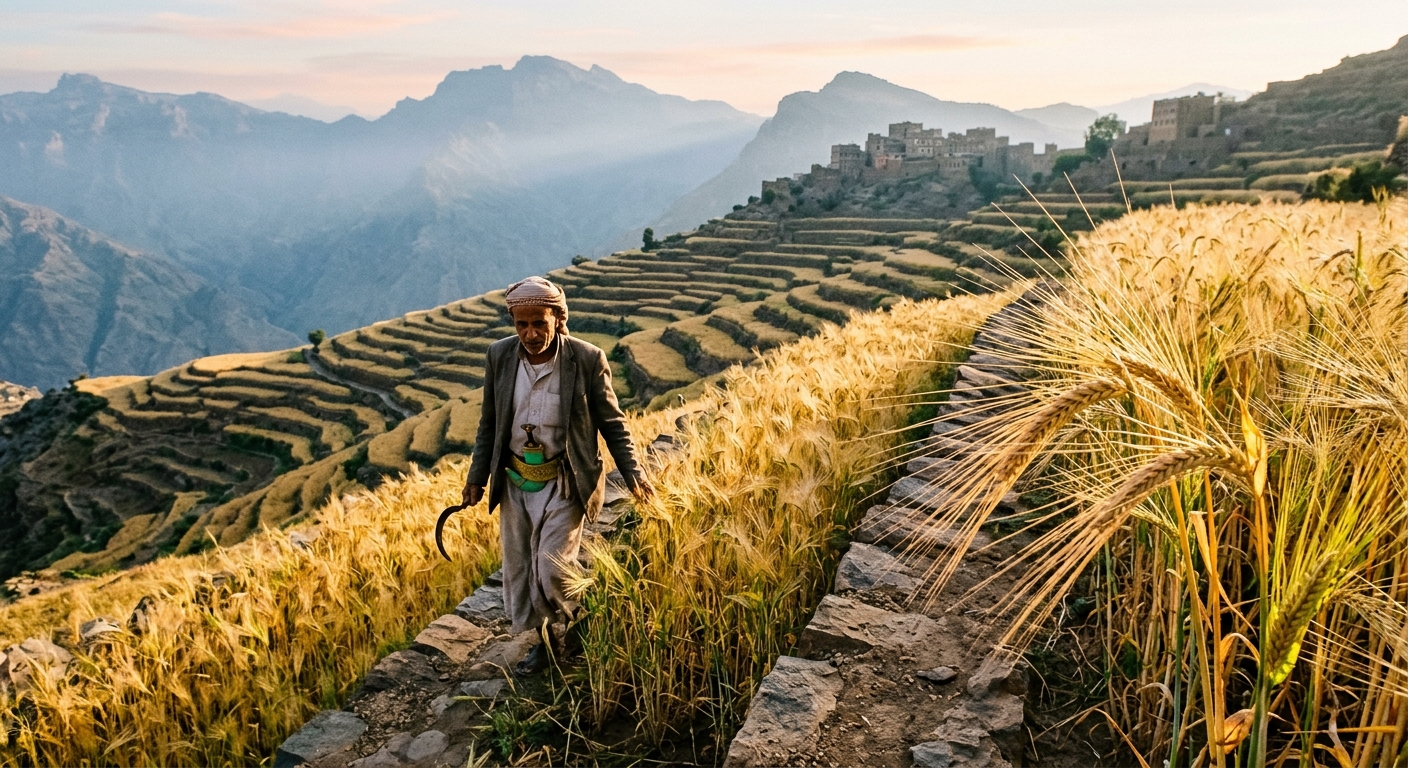
This study aims to dissect the value chain of the barley crop (Hordeum vulgare L.) in the Republic of Yemen for the year 2026. Barley is considered one of the most strategic crops linked to rural food security and the sustainability of the livestock sector, particularly in an environment suffering from persistent drought, fragmented agricultural holdings, and the most severe water crisis globally.
Barley (Hordeum vulgare L.) is one of the oldest crops domesticated by humans in the Fertile Crescent over 10,000 years ago. From there, it spread globally to become the fourth most important cereal crop in the world in terms of production volume, following corn, wheat, and rice. Cereals play a vital role in global food security, with the annual global productivity of barley reaching approximately 145 to 150 million metric tons. Globally, its uses are distributed among animal feed (over 65%) and the malt industry (30%), while direct human consumption accounts for no more than 5%.
In Yemen, the history of barley cultivation spans thousands of years, inextricably tied to the ancient mountainous terrace system and traditional flood and rain-fed irrigation. Barley represents a safety valve for the Yemeni farmer in high altitudes, given its exceptional ability to withstand harsh climatic conditions, water scarcity, and poor, exhausted soils where wheat cannot grow.
Yemeni local (Baladi) barley is distinguished by unique genetic characteristics, including:
Economically, barley falls within the category of staple cereal crops that contribute to anchoring farmers to their lands, curbing rural-to-urban migration, and conserving foreign currency by reducing reliance on imported feeds.
Based on recent agricultural statistical reports, the volume of barley production in Yemen is estimated at 30,000 to 42,000 metric tons annually. It is cultivated on an estimated area ranging between 28,000 and 37,000 hectares, representing about 6% of the total cereal area in Yemen. The following table illustrates the distribution of barley production in Yemen across three main environmental zones in the mountainous highlands:
Table (1): Distribution of Barley Production in Yemen
| Geographical Zone | Main Governorates | Percentage of Barley Agricultural Area | Average Actual Yield | Cultivated Varieties (Local/Baladi and Improved) |
| Northern Highlands | Amran, Sanaa, Saada, Hajjah, Al Mahwit | 57.7% | 0.96 tons/ha | Saklah and Bakor (two-row local varieties, highly drought-tolerant). |
| Central Highlands | Dhamar, Al Bayda | 28.6% | 1.50 tons/ha | Masdos and Aswad Mahli (six-row local varieties), and Mobasher (improved variety). |
| Southern Highlands | Ibb, Taiz | 6.5% | 1.98 tons/ha | Arifat (improved six-row variety), and Habib: an improved naked barley variety (Hordeum vulgare var. nudum) developed through research. |
| Other Regions | Edges of Valleys and Eastern Plateaus | 7.2% | 1.33 tons/ha | A mixture of local and Baladi varieties. |
Generally, Yemen relies on imports to cover about 80% to 85% of its total cereal needs (especially wheat and maize for food and concentrated feed purposes). Although local barley is entirely consumed locally and there is no severe consumption gap in “traditional human food barley,” there is a massive gap and a severe deficit in the animal feed sector. Yemen is forced to import large quantities of feed barley for the poultry and livestock sector, creating continuous economic pressure.
Due to the large gap between local production and the growing demand for concentrated feeds and specialized food industries, Yemen relies on foreign imports to secure a large portion of its needs. The following table details the imported quantities and costs of both feed and food barley for the year 2025/2026:
Table (2): Details of Imported Quantities and Costs for Feed and Food Barley (2025/2026)
| Type of Imported Barley | Main Purpose of Use | Annual Imported Quantity (Metric Tons) | Average Import Price per Ton (USD) | Average Total Annual Cost (USD) | Main Countries of Origin |
| Feed Barley | Concentrated feed factories (for poultry) and direct livestock feeding | 150,000 – 200,000 | $280 – $300 | $45,000,000 – $60,000,000 | Russia, Ukraine, Romania, European Union |
| Food Barley | Preparation of specialized health nutrition products, ready-made Talbina, imported barley flour | 500 – 1,500 | $800 – $1,000 | $400,000 – $1,200,000 | India, Turkey, Saudi Arabia, UAE (re-export) |
| Total | Combined Consumption | 150,500 – 201,500 | — | $45,400,000 – $61,200,000 | — |
Note: These figures represent average estimates resulting from cross-referencing data from the Ministry of Agriculture and Irrigation, Yemen Customs, and the Food and Agriculture Organization (FAO) foreign trade data for 2025/2026. They clearly indicate that the largest bill is concentrated in feed barley.
Yemeni barley exports are almost non-existent from an official commercial perspective (less than 50 tons annually). Exports are limited to very small quantities of premium Baladi barley directed as niche markets for Yemeni expatriates in neighboring countries (Saudi Arabia, Oman, and the UAE) and are exported at high prices compared to global feed barley.
Despite sharing the same scientific name (Hordeum vulgare L.), genetic and biological differences, alongside varying agricultural practices, separate the product intended for human tables from the product intended for fattening troughs and poultry, as illustrated in the following table:
Table (3): Genetic and Biological Differences Between Food-Grade and Feed-Grade Barley
| Basis of Comparison | Food-Grade Barley | Feed-Grade Barley |
| Protein Level | Preferably moderate to low (between 9.5% and 11.5%) to ensure ease of milling and cooking, and to avoid a bitter taste. | Targets the highest possible protein percentage (exceeding 12% to 15%) to increase nutritional value and build muscle in livestock and poultry. |
| Fiber Level | Preferably high in soluble fibers like Beta-glucan for heart and digestive health benefits, with a thin, easily peelable outer husk. | Contains a high percentage of crude (insoluble) fiber suited for the digestive system of ruminants (cattle/sheep). Naked varieties are developed specifically for poultry to facilitate digestion. |
| Grain Shape & Spike Type | Dominated by two-row barley, which produces plump, uniformly sized grains that are rich in starch and easy to polish and hull. | Dominated by six-row barley, which produces a larger number of grains per spike but with smaller, non-uniform sizes and thicker husks. |
Agricultural recommendations and field management strategies differ fundamentally based on the ultimate goal of the crop, whether it is directed for human consumption as “food barley” or for livestock nutrition as “feed barley.” These managerial differences manifest in three key areas:
Handling nitrogen fertilization requires high precision that varies by objective. For food barley, nitrogen is applied very cautiously and in measured quantities; excessive application raises the protein percentage in the kernels above acceptable consumption limits and softens the stem, exposing the crop to the risk of lodging and quality deterioration. Conversely, nitrogen fertilization is intensified in feed barley to maximize vegetative growth and increase the quantity of produced straw and hay, while simultaneously maximizing the total protein percentage within the grains to enhance their nutritional value for livestock.
Plant spacing and seeding rates are influenced by the cultivation objective. Feed barley is sown at a high density to yield thin stems and dense foliage that are easy for animals to digest, whether the crop is harvested as fresh green fodder or dried as hay. Food barley, on the other hand, is sown with wider spacing to allow for good ventilation and sunlight penetration between plants, ensuring the growth of plump, healthy grains and reducing the likelihood of fungal disease outbreaks.
Harvesting conditions and crop purity are subject to strict standards in the food sector compared to the feed sector. Food barley requires strict adherence to pesticide safety periods and guarantees that shipments are completely free of gravel and toxic weed seeds (such as darnel) to maintain consumer safety. In contrast, the feed sector partially tolerates minor percentages of natural impurities or non-toxic husks, provided they do not affect the livestock’s health and the feed’s nutritional value.
In Yemen, farmers do not plant entire fields strictly designated as “pure feed barley” using commercial global varieties. Instead, they apply an integrated system known as the “Dual-Purpose Production System.” This system is evident in regions like Dhamar, Amran, and Sanaa, where farmers cultivate historical Baladi varieties (such as Saklah, Bakor, and Masdos). They carefully sort the harvest: clean, plump grains are directed toward human consumption to prepare traditional meals like Talbina, Aseed (porridge), and barley bread, which form the food safety valve for the rural family. Conversely, broken and coarsely cracked/rolled grains are utilized as concentrated feed for domestic livestock (cows and sheep), while avoiding fine milling to prevent the risk of acute rumen acidosis. The straw, known locally as “Tibn” or “Thibl,” represents the backbone of livestock nutrition in the rural Yemeni highlands. In drought seasons and periods of low rainfall, the economic equation completely inverses; the market value of barley straw surpasses the value of the grains themselves. This leads the Yemeni farmer to view barley cultivation primarily as a fodder production project to save their herd from perishing, and secondarily as a human food production project.
When climatic conditions intensify and rains are delayed in certain central highland regions (such as Dhamar and Yarim), farmers resort to a cultural practice known as “Green Grazing/Forage.” Once they confirm the crop’s inability to form mature spikes, they proactively mow the barley fields while still green and tender before the heading stage (spike emergence) to offer it as fresh green fodder—notable for its high moisture and protein content—to lactating cows.
In recent years (specifically from 2020 to 2026), Yemen has witnessed a qualitative leap in adopting hydroponic barley sprouting technology. This modern development emerged in response to the continuous drought crisis and the fragmentation of agricultural holdings, which prevented the expansion of traditional open-field feed barley cultivation, making this technology a strategic and effective alternative for breeders.
The operational mechanism of sprouting projects in the Yemeni context relies on purchasing barley grains—often cheap imported feed barley—as a primary production input. These grains are placed in designated trays inside insulated rooms with fully controlled environments (temperature, humidity, and lighting). Within just 7 days, the grains sprout into dense green mats of leaves and roots, rich in proteins and feed enzymes. In terms of feasibility and current indicators, this technology offers high production efficiency. Producing one ton of green fodder requires a footprint of no more than 50 square meters inside sprouting rooms, compared to the hectares of open agricultural lands previously required. Furthermore, this technology boasts up to 90% less water consumption compared to cultivating traditional fodder like alfalfa in open fields, offering a solution to the water crisis in the Sanaa and Amran basins. As a result of these encouraging metrics, several local initiatives are currently active in locally manufacturing sprouting rooms and providing designated barley to breeders and dairy/poultry farm owners.
Barley inputs account for 35% to 40% of the total production costs per hectare. The distinctiveness of this stage is evident in the farmers’ over 85% reliance on self-saved Baladi seeds from the previous harvest. This is primarily due to the near-total absence of certified barley seed multiplication and distribution programs by government institutions, which direct 95% of their focus toward wheat seeds. Alongside seeds, traditional organic fertilizer (manure, or sheep and cow dung) emerges as another high-cost, highly demanded key input for barley to compensate for poor soil in high-altitude terraces. However, this prolonged reliance on and repeated generational use of self-saved local seeds leads to tangible genetic degradation, seed mixture with weeds (Avena fatua, Lolium temulentum), and susceptibility to seed-borne fungal diseases such as loose smut (Ustilago nuda), covered smut (Ustilago hordei), and field rust. Weeds like wild oats and darnel are difficult to separate manually due to grain size similarities, causing a direct quantitative drop in yield by up to 30% and a decline in the crop’s market value due to its low purity. Cumulatively, the average cost of specialized inputs for barley is estimated at about $300 to $400 USD per hectare. This cost includes the value of stored Baladi seeds, initial plowing costs, and the high cost of transporting organic manure across rugged mountain terraces.
In the production stage, over 90% of barley in Yemen is cultivated under a strictly rain-fed agricultural system. Seeds are broadcasted manually and then covered using traditional animal-drawn wooden plows on extremely narrow terraces inaccessible to large agricultural machinery. The “extremely narrow harvest window” is considered the most critical and specific practice for barley, given the high fragility of the Baladi barley’s spike axis (rachis). If the harvest is delayed for a few days or conducted during hot, dry daylight, the spikes are subjected to spontaneous shattering, and grains fall to the ground. This forces farmers to perform arduous manual harvesting with sickles during early dawn hours, utilizing air moisture and dew to prevent spike breakage. Productivity faces critical constraints leading to a very wide yield gap. The current actual average yield is 1.2 tons/hectare, compared to a potential capacity of 2.5 tons/hectare if life-saving supplementary irrigation systems were introduced during long dry spells at the heading and grain-filling stages. The biggest obstacle remains the severe fragmentation of holdings on rugged terraces and the high intensity of manual labor, raising the nominal estimated cost of producing one kilogram of Baladi barley to $0.80 – $0.90 (equivalent to $800 – $900 per ton). This figure shows a sharp apparent gap when compared to imported feed barley prices at the ports ($280 – $300 per ton). However, this discrepancy is economically explained by the nature of the dual-purpose system. The farmer does not grow barley to sell as cheap feed grain; rather, the value of the resulting hay and feed straw offsets a large part of the manual labor cost and sometimes exceeds the grain value itself during drought seasons. Meanwhile, clean grains are directed either to household consumption or to health food and herbal markets at lucrative prices exceeding $1.50/kg. This makes direct comparisons with imported grain prices misleading unless the straw’s return is factored in.
The challenges of post-harvest transactions begin immediately after the manual collection process. Barley sheaves are transported to the “Migran” (a public dirt yard in the village) to dry under the sun for several days. Traditional threshing is then performed by driving tractors or livestock in a circular motion over the spikes, followed by wind winnowing to separate the straw from the grains. These primitive practices cause disastrous qualitative issues specific to barley. Primarily, the grains become highly contaminated with gravel and soil that stick to the rough, pointed edges of the barley husk (Glume/Lemma). They also result in a high rate of broken grains, stripping them of their vitality and making them prone to rapid spoilage during storage. Additionally, there is a significant loss of barley straw (hay) which blows away during winnowing, despite its high economic value—often equaling the grain value itself during dry seasons—as a primary livestock feed in rural areas.Quantitative and Financial Impact: As a result of these primitive practices, the estimated quantitative loss (during harvesting, threshing, winnowing, and storage stages) ranges between 18% and 25%. This quality degradation directly reflects on the farmers’ financial returns; middlemen impose a direct price deduction ranging between 15% and 20% on a bag of local barley if soil impurities resulting from ground threshing are detected.
Regarding processing and value addition, about 90% of Baladi barley is directed toward direct, unprocessed consumption (either as whole grain feed for livestock or via domestic milling to produce coarse bread). Only 10% is directed toward milling and packaging to produce barley flour or Talbina in small local mills. Investment and establishment attempts in this field hit a major structural technical obstacle: the presence of a hard, outer siliceous husk firmly adhering to the kernel, coupled with Yemen’s near-total lack of specialized barley hulling and polishing machines. Consequently, milling barley directly without hulling in traditional mills produces a very coarse powder rich in sharp husk fibers. It has a bitter, unpalatable taste for urban consumers and causes rapid wear on milling parts. This highlights the absence of integrated production lines that start with hulling, proceed to sifting, and conclude with fine milling and automated packaging to prevent commercial fraud. Despite these obstacles, huge untapped opportunities exist for innovation and product diversification, most notably:
The current economic reality shows that the capacity utilization rate of specialized barley mills and hullers is below 10%, whereas this sector possesses a promising growth opportunity. The additional profit margin generated from selling hulled and processed barley as packaged Talbina ranges between 25% and 35%.
The Yemeni barley market is characterized by a complete split into two separate markets with entirely different pricing mechanisms and dynamics. The first is the feed market (feed barley and hay), heavily traded in weekly rural livestock markets, where prices are directly affected by drought seasons, rainfall rates, and imported bran prices. The second is the food and health market (premium Baladi barley and Talbina), sold in specialized herbal shops and organic product stores in major cities like Sanaa, Taiz, and Aden. In the food and health market, local brokers and middlemen possess absolute negotiating power. They exploit the farmers’ need for cash to buy the crop from them immediately after harvest at low prices, then store it to resell at double the price during seasons of scarcity as a natural and therapeutic product for colon, kidney, and diabetes ailments. This monopoly, alongside the traditional storage costs incurred by these brokers, reflects in a large price gap for Baladi barley between the harvest season (September) and the scarcity seasons (May), where prices surge by up to 40%. As for the distribution of profit margins from the final consumer price in the premium food pathway, the deducted share for the original producer (the farmer) is only 45% of the final price—a meager share considering they bear the grueling production and harvesting costs. In contrast, the rest of the returns go to other rings of the marketing chain; the regional broker or middleman takes a 20% share, 15% goes to mills and manual packaging workshops, while the retailer (herbalists and health food shops) receives 20%—a very high margin primarily due to the crop’s classification as a health and therapeutic product. Regarding the efficiency of market access channels, current marketing channels are primitive and fragmented. The commercial environment completely lacks any pre-supply contracts between farmers’ associations and feed factories or urban health food companies, which ultimately deprives the Yemeni farmer of the advantage of obtaining a stable and fair price for their crop.
Table (4): Map of Key Players in the Value Chain and Their Hierarchy
| Key Player | Central Role in the Chain | Current Shortcomings and Negative Impacts | Development and Practical Empowerment Proposals |
| Input Suppliers (Seeds & Fertilizers) | Providing Baladi and improved barley seeds, fertilizers, organic manure, and field pesticides. | Complete absence of specialized barley seed companies; available seeds are contaminated with weeds and highly priced, alongside fluctuating chemical fertilizer prices. | Establish a cooperative-backed “Community Barley Seed Bank” at the village level, and train local suppliers on mechanical seed sifting and cleaning before sale. |
| Smallholder Farmers (on high terraces) | Performing all field operations: plowing, sowing, crop care, arduous manual harvesting, and separating straw from grains. | Sharp increase in manual production costs, severe water shortages, and significant field losses during harvest due to spike shattering. | Systematic transition from random broadcasting to sowing in rows (3-5 cm depth) using manual seeders to reduce seed rates to 80-100 kg/ha. Harvest at 14%-16% grain moisture for manual harvesting, and 18%-20% for mechanical harvesting with immediate drying to prevent rachis breakage. Introduce small mechanical hand reapers suitable for narrow terraces, and provide rainwater harvesting systems for supplementary life-saving irrigation. |
| Local Intermediaries (Aggregators & Brokers) | Purchasing grain and hay at the farm gate, transporting, re-marketing, and storing for sale in major cities. | Absolute monopolistic control over purchasing prices immediately post-harvest, exploiting the farmer’s need for cash, and imposing unfair price deductions under the pretext of impurities. | Organize rural markets, enforce selling by weight and grade, set indicative prices, and establish direct sales points affiliated with agricultural cooperatives to bypass brokers. Construct sealed community storage facilities. |
| Mill Owners & Food Factories | Milling Baladi barley into fine flour, Talbina products, or nutritional supplements, followed by packaging and sales. | Complete lack of specialized barley hullers to remove the hard siliceous husk prior to milling, resulting in a coarse, bitter-tasting product with low consumer acceptance. | Introduce mechanical barley dehullers/purlers equipped with stone cylinders and air aspirators to remove the siliceous husk (Lemma/Palea) at the milling level. Train technicians on safe barley grain refining and milling technologies. |
| Retailers (Spice, Herbal, & Health Food Stores) | Selling and distributing processed barley products (flour, Baladi Talbina, hulled grains) directly to end consumers in urban centers. | Absence of premium packaging standards, reliance on open “loose” sales susceptible to dust contamination, massive price disparities, and high profit margins for middlemen. | Shift to automated, sealed packaging; use informative labels detailing health benefits and preparation methods; and forge direct supply agreements with barley producer associations. |
| Livestock Breeders (Cattle/Sheep) | Direct consumption of barley straw (hay) and secondary grains as roughage on farms or rural households. | Traditional, undeveloped use of straw as low-protein roughage without technical processing to increase its digestibility and nutritional content. | Introduce barley straw baling technology and train breeders on treating hay with urea and molasses to raise the feed’s protein percentage and lower nutrition costs. |
Table (5): Stakeholders: Roles, Shortcomings, and Development Proposals
| Stakeholder | Actual Role and Strategic Importance | Institutional and Operational Shortcomings | Proposals for Effective Development and Coordination |
| Ministry of Agriculture and Irrigation (Extension Offices) | Policymaking, directing financial/in-kind support, and providing technical extension guidance to farmers in the field. | Near-total neglect of the barley crop, focusing 95% of efforts on wheat and maize, coupled with weak operational budgets for extension workers. | Launch the “National Program for Revitalizing and Developing the Barley and Fodder Sector,” and provide extension publications on safe barley harvesting and storage practices. |
| Agricultural Research and Extension Authority (AREA) | Developing and testing new high-yield, high-quality, drought-resistant varieties suitable for Yemen’s agro-ecological zones. | Inadequate budgets for producing foundation seeds of improved varieties (like the naked Habib variety) and limited farmer access to research outcomes. | Activate partnerships with development organizations to fund seed multiplication fields for resistant varieties, and establish specialized research units for rain-fed barley. |
| General Corporation for Seed Multiplication | Multiplying improved seeds certified by the research authority and providing them to cooperatives and farmers at reasonable prices. | Complete failure to provide certified barley seeds; multiplication plans have been exclusively focused on wheat, maize, and potatoes for years. | Include barley seeds (especially dual-purpose and naked varieties) in annual multiplication plans and contract pioneer farmers to produce clean seeds. |
| International Organizations (FAO, UNDP, WFP) | Providing emergency aid and development projects to build resilience, supply inputs, and support rural families. | Focusing on distributing insufficiently purified emergency seeds via short-term response methods, without considering value chain sustainability and asset building. | Direct funding toward productive assets with sustainable impact, such as providing hullers and threshers to cooperatives and equipping sprouting rooms with solar power. |
| Financing Institutions & Microfinance Banks | Providing financial facilities and loans to fund small activities and projects for rural farmers and entrepreneurs. | Banks’ reluctance to finance agriculture due to high risks, requiring complex guarantees unavailable to smallholder barley farmers and processors. | Design Sharia-compliant financial products specifically for barley, relying on community guarantees and agricultural cooperatives as loan guarantors. |
To address the aforementioned structural bottlenecks and transform Yemen’s barley farming into a highly profitable and productive sector, we propose the following customized strategic intervention package:
Table (6): Strategic Interventions Linked to Financial Models, Costs, and Timelines
| Proposed Strategic Intervention | Targeted Sector in the Chain | Proposed Realistic Financial Model in Yemen | Partner Financing & Executive Entities | Estimated Cost | Implementation Timeline | Financial Impact & Long-term Sustainability |
| 1. Purification and Cleansing Program for Baladi Landraces | Inputs & Production | 100% Joint Development Grant | AREA, Ministry of Agriculture, FAO | $45,000 USD | 6 – 12 Months | Training a pioneer extension cadre and distributing traditional community manual sorting tech, generating sustainable impact by allowing farmers to keep pure seeds for years for free. |
| 2. Expansion of Multiplying the Naked “Habib” Variety | Inputs & Production | Subsidized contract farming agreements for seed purchasing | Seed Multiplication Corp., Agricultural & Fishery Production Promotion Funds, Cooperatives (as guarantors) | $60,000 USD | 12 – 24 Months (1-2 seasons) | Purchasing foundation seeds from research stations and distributing them at nominal prices to contracted seed farmers, with the Corp. committed to repurchasing the harvest to circulate benefits. |
| 3. Introduction of Small Mechanical Hand Reapers | Inputs & Production | Participatory soft (interest-free) loan (50% in-kind grant / 50% lease-to-own) | Micro & Small Enterprise Development Entities, Finance Banks | $80,000 USD (Approx. 42.4 M YER) | 6 – 9 Months | Providing 200 portable mechanical reapers suitable for steep terraces; 50% of the cost is paid by the farmer in easy post-harvest installments via the cooperative. |
| 4. Introduction of Abrasive Cylinder Barley Dehullers | Post-Harvest & Processing | Revolving cooperative fund backed by a 70/30 matching grant | Social Fund for Development (SFD) (70%), Beneficiary Agricultural Cooperative (30%) | $120,000 USD (Approx. 63.6 M YER) | 9 – 15 Months | Purchasing and localizing 20 medium mechanical dehullers for cooperatives; serving farmers for a nominal fee dedicated to machine maintenance and sustainability. |
| 5. Introduction of Large Rotary Mechanical Sifters | Post-Harvest & Processing | 100% Community Productive Asset Financing | UNDP (under the Resilient Livelihoods framework for vulnerable rural communities) | $50,000 USD (Approx. 26.5 M YER) | 3 – 6 Months | Equipping village-level intermediate aggregation points to sort and sift the barley crop, ensuring it is delivered to merchants free of dust and gravel, directly increasing profit margins. |
| 6. Baling and Treating Barley Straw with Urea & Molasses | Post-Harvest & Processing | Collective entrepreneurial microfinance portfolio | Microfinance Banks partnered with Agricultural Cooperative Unions | $35,000 USD (Approx. 18.55 M YER) | 4 – 8 Months | Providing soft loans to rural youth groups to purchase mobile balers and straw treatment equipment, operating as contractors serving local breeders for a fee. |
| 7. Premium Commercial Packaging for “Baladi Talbina“ | Processing, Marketing, & Value Addition | Cooperative investment partnership and franchise agreement | Private sector local food packaging companies, Agricultural Cooperatives (for supply guarantee) | $75,000 USD (Approx. 39.75 M YER) | 6 – 12 Months | Establishing a sterilized model center to automatically purify, mill, and package Yemeni Talbina under the cooperative’s name, marketed as a national brand yielding high cash returns. |
| 8. Supporting and Localizing “Hydroponic Barley Fodder” Rooms | Processing, Marketing, & Value Addition | Soft green financing portfolio for alternative energy and water tech | Microfinance Banks, Relief and Development Institutions | $250,000 USD (Approx. 132.5 M YER) | 12 – 18 Months | Localizing the manufacturing of sprouting rooms in Yemen to cut costs, and providing long-term soft loans to dairy farm owners to purchase solar-powered rooms. |
| 9. Activating Direct Marketing Linkage Contracts | Processing, Marketing, & Value Addition | 100% Institutional Networking and Empowerment Support | Ministry of Agriculture, Ministry of Economy, Industry, and Investment | $15,000 USD (Approx. 7.95 M YER) | 3 – 6 Months | Building a simple digital communication platform and training cooperative representatives to secure direct forward supply contracts for straw and grain with major dairy and poultry farms. |
If the full package of recommended agricultural and technical interventions is implemented, analytical data projects a massive leap in national production and economic benefits for barley. Assuming the current agricultural area allocated for barley in Yemen remains constant at an average of 32,500 hectares, the impact on national production can be calculated as follows:
Calculation:
This represents an estimated net increase in locally available barley quantities of about 124.6% (more than doubling the actual net domestic supply) without the need to consume new lands, relying solely on vertical improvement and loss reduction.
Financial Returns and Economic Savings from Import Substitution Based on cost differentials, the targeted 35,000-ton domestic production increase should not be directed to compete with cheap imported feed barley. Instead, it should be distributed across two highly economically viable pathways:
To ensure a fair and logical comparison based on realistic 2026 Yemeni market figures, a parallel exchange rate of $1 USD = 530 YER (Sanaa parallel market) was adopted. The operational period was unified to 90 days (equivalent to one growth cycle for soil-based traditional barley). The comparison pits one full hectare (10,000 m²) of open soil against a fully equipped 50 m² hydroponic sprouting room (producing 500 kg of green fodder daily).
Table (7): Technical, Quantitative, and Financial Comparison
| Basis of Comparison / Evaluation Criterion | Traditional Soil Farming (1 Hectare) | Advanced Hydroponic System (50 m² Room) |
| Exploited Geographical Area | 10,000 m² (1 Hectare) | Only 50 m² (using multi-layer racking systems) |
| Growth & Production Cycle Duration | 90 to 110 days (one crop per season) | Only 7 days (continuous cycle, daily harvest year-round) |
| Total Green Fodder Production (in 90 days) | Approx. 10 tons (early-cut fresh green fodder) | Approx. 45 tons (at a daily production rate of 500 kg) |
| Grain-to-Fodder Conversion Ratio | Approx. 1:1.5 (1 kg of seed yields 1.5 kg of vegetative mass) | Approx. 1:7 (1 kg of grain yields 7 kg of green fodder via water absorption) |
| Total Water Consumption (over 90 days) | Approx. 4,500 to 5,000 cubic meters | Approx. 15.7 cubic meters (consuming 350 liters per ton of fodder) |
| Water Savings Percentage | 0% (Baseline) | Exceeds 99.6% water savings compared to open soil |
| Reliability & Environmental Control | Completely dependent on rain and weather (vulnerable to drought and frost) | Fully insulated and controlled (lighting, temp, humidity) via solar power |
| Initial Capital Expenditure (CapEx) | Approx. $200 USD (manual tools, basic irrigation lines if any) | Approx. $5,000 USD (insulated room, racks, misting system, solar power) |
| Asset Depreciation Value (for 90 days) | Approx. $10 USD | Approx. $250 USD (assuming a 5-year depreciation lifecycle) |
| Operational Inputs Cost (for 90 days) | Approx. $690 USD (Baladi seeds, manure, plowing, labor) | Approx. $2,428 USD (purchasing 6,428 kg of imported seed barley, sterilization, power) |
| Total Operational Expenditure + Depreciation (OpEx) | Approx. $700 USD (Approx. 371,000 YER) | Approx. $2,678 USD (Approx. 1,419,340 YER) |
| Average Production Cost per Ton of Fodder | Approx. $70 USD (Approx. 37,100 YER) | Approx. $59.5 USD (Approx. 31,535 YER) |
| Market Value of Production (at avg. $100/ton) | Approx. $1,000 USD (Approx. 530,000 YER) | Approx. $4,500 USD (Approx. 2,385,000 YER) |
| Net Financial Profit Achieved (over 90 days) | Approx. $300 USD (Approx. 159,000 YER) | Approx. $1,822 USD (Approx. 965,660 YER) |
| Digestibility & Animal Nutritional Value | Hard-to-digest crude fibers, low protein (6% – 8%) | Enzyme-rich, highly digestible (85%+), high protein (15% – 18%) |
Currently manufactured locally in Yemen, the initial setup cost of roughly $5,000 USD (2,650,000 YER) breaks down as follows:
To ensure high-efficiency operations and avoid the massive losses experienced by novice breeders in Yemen, health control and biosecurity standards are the cornerstones of project sustainability. The most common field challenge arises from high humidity and temperature inside the rooms, making the trays a breeding ground for fungal infections, mold, and foul odors. This environmental degradation not only ruins the crop but causes animals to reject the feed, leading to toxicity in severe cases of mold spore contamination. To combat this, a strict preventative biosecurity protocol is proposed across four pillars:
Adhering to biosecurity protocols to produce clean fodder yields indirect positive impacts on herd productivity, granting the Yemeni breeder indirect economic advantages that far exceed the raw numerical value of selling the fodder. This viability manifests in three distinct production pathways:
The barley crop in the Republic of Yemen represents an overlooked pillar with exceptional potential to combat climate change, rural poverty, and economic decline. Transforming this crop from a traditional subsistence model to a highly efficient sector inevitably requires a participatory, progressive, and technological approach. Adopting this integrated vision, coupled with the proposed financial models, will enable Yemen to curb the depletion of foreign currency spent on imported concentrated feeds. Simultaneously, it will elevate the living standards of smallholder farmers and livestock breeders, laying a solid foundation in the wall of national food sovereignty.
Recommendations: Do not treat barley as an isolated agricultural entity. Instead, integrate it into a unified agricultural policy framework for dryland cereals in the highlands and plains, alongside wheat, sorghum, and millet. Its developmental roles should be synergized by assigning it the task of rural fodder security—given its genetic superiority in producing hay during drought years compared to other cereals. Furthermore, mechanical abrasive dehullers must be localized at the rural cooperative level to remove the siliceous husk, opening avenues for highly profitable health food and bakery processing. Finally, hydroponic sprouting rooms—funded by credit and development institutions—must be adopted as an advanced water-saving tool operating on imported grains, specifically designed to protect national dairy farms and conserve groundwater basins.
Note: Accepted Exchange Rate: All costs and prices were evaluated in USD according to the parallel exchange rate of $1 USD = 530 – 535 Yemeni Rials.